By Golly, Ollie!

💾 a blog about books, tea, & geekery

Tag: green tea

Posts about green tea, a kind of tea that is neither withered or oxidized

  • Teas to Sip While Reading Mayflower: A Story of Courage, Community, and War by Nathaniel Philbrick

    Teas to Sip While Reading Mayflower: A Story of Courage, Community, and War by Nathaniel Philbrick

    Like many folks, or at least like the folks in my liberal echo chamber of the internet, I spent a fair amount of 2020 in lockdown unlearning everything I was taught in U.S. History class. Then I was, at some point, struck with the desire to take a somewhat-chronological deep dive into U.S. History and read nonfiction books from an array of perspectives. So, I started my journey with Mayflower: A Story of Courage, Community, and War by Nathaniel Philbrick. It’s a nonfiction novel that explores the national myth of the Pilgrims landing at Plymouth Rock and the first Thanksgiving, the relationship between Native Americans and English colonists that degraded over time, and inevitably the deadly wars such as the Pequot War and King Philip’s War.

    In hindsight, I probably should have chosen a book about Jamestown, but I forgot that was the first English colony until several pages into Mayflower. Or better yet, I should have started with 1491: New Revelations of the Americas Before Columbus by Charles C. Mann, which presents evidence that the Indigenous peoples of the Americas were more numerous and more culturally and technologically sophisticated than is taught in school. Yet, here we are, caught ‘tween decks with 102 Mayflower passengers, sailing for months across 3,000 miles of the ocean toward a land unknown to most Europeans of the time.

    I Love to Hate the Puritans.

    It is a love that stretches all the way back to 10th grade U.S. Literature thanks to The Scarlet Letter by Nathaniel Hawthorne and the Crucible by Arthur Miller. The Puritans…are a real piece of work.

    If you’re not familiar, or if your history is a little rusty, the Puritans were Protestants in the 16th and 17th centuries, who followed the teaching of John Calvin. They sought to purify the Church of England of Roman Catholic practices, and they believed salvation or damnation was predetermined by God, so there was nothing a person could do in life to change that outcome.

    The Pilgrims (of Plymouth Rock fame) were a sect of Puritans who, instead of preoccupying themselves with purifying the Church of England, separated from the church and created their own congregation to meet their pious, spiritual standards. This was illegal in England, so Pilgrims were persecuted (like, properly persecuted– imprisoned or executed), and to escape persecution, the Pilgrims initially fled to Leiden, Holland. Despite being able to practice their religion in peace in their new home, the Pilgrims found themselves losing their English identity, so they sought a new land where they could carve out their own New England and plant their roots and church.

    Don’t get me wrong, the Pilgrims were on stolen land and they brought deadly diseases, but I found myself fascinated by this group all the same. They mostly kept to themselves, and the strength of their community was admirable. The ways they held each other accountable– to ensure each member of the church worshipped God properly– was interesting, too. After church sermons, the Pilgrims would sit around and listen to inspired lectures about religious doctrine from nearly everyone in the congregation for HOURS. (When did they get any work done?) Also, despite their religiosity, the Pilgrims insisted on the separation of church and state. Even their marriages were secular because the Bible says nothing about a minister being involved in wedding ceremonies.

    And so, while the Pilgrims may not have been the actual worst, their degenerate spawn (their words, not mine) as well as the non-separatist Puritans that emigrated afterward were. Like, literally, the worst. Ironically, the Puritans fled to America to escape religious persecution only to turn around and become the persecutors themselves. After settling in America, they forced all non-European Puritans living in their colony to assimilate into their religion. Or, they shunned neighboring colonies of Quakers. Or they actively persecuted folks like Thomas Morton, whose Anglican practices made him look like a heathen pagan to the Puritans.

    Not to mention, they monopolized the purchase and sale of Native American land thereby cheating Native Americans out of free and fair trade.

    Also, the genocide and enslavement of the Native Americans.

    Like, it’s absolutely stunning how a group of godly people can be so inhumane and awful. And, it becomes even more horrifying when predestination is factored in because then all of their actions become “God’s will”, and I think that says a lot about the Puritans (and why I love to hate them), the founding of Colonial America, and eventually the founding of the United States.

    Even though the birth of the United States was more than a century away, some of the nations defining qualities began to develop (for better or for worse).

    For example, the Pilgrims shifted away from communal farming to farming their own, private plots of land, where they were permitted to keep their own produce. Crop yields grew exponentially, which paved the way for capitalism. We also see the beginnings of American individualism and frontiersmanship in people like Benjamin Church (Captain of the first Ranger force in America). American frontiersmen became invaluable during the United States’ westward expansion but also contributed to the continued genocide of the Native Americans. And, who could disregard the burgeoning intolerance of different cultures and especially religions, which began to bubble at Plymouth colony?

    The Puritans were advocates for public education though, so there is that.

    I have a hard time wrapping my head around how anyone survived back then. Especially before the invention of electric heat.

    At the time of writing this, I’m wearing a sweatshirt, and I’m buried under two blankets. I also have a newly insulated attic. And even though the heater is running, I’m still cold. The Pilgrims arrived in North America at the start of winter during the Little Ice Age, and somehow they survived. (Also, one of the Pilgrims notes that the Native Americans they first meet are hardly wearing clothes. This can’t be true, can it?)

    I also wonder how many calories did these people eat? Their only mode of transportation in America was walking the trails between settlements, which could take days to traverse. Not to mention, they always seem to be at war or farming or clearing forests or building houses. Seriously, how did they stay sufficiently fed? (Especially since the Pilgrims sucked at hunting and fishing, and they did not have livestock in the early years of the colony).

    And don’t even get me started about sailing across the ocean at night before the invention of radar. It’s bananas.

    Philbrick addresses biases and does a decent job of balancing perspectives about Native American and colonist relations.

    Before beginning the story, Philbrick addresses that most of what we know of 17th century New England comes from the English. And even though in recent decades, anthropologists, archaeologists, and folklorists have increased the world’s understanding of Native American culture and history during this time, Philbrick’s reconstruction is predominantly pulled from the written histories and letters of the Puritans. He is more sympathetic to the Pilgrims than perhaps a Native American historian might be, but Philbrick doesn’t romanticize the colonization of Plymouth, either. He is critical of the Pilgrims and their descendants where it is undeniably due.

    Mayflower attempts to bridge the gap between what is usually taught about the founding of the United States.

    In school, we tend to learn about Jamestown and Plymouth Rock, but then we fast forward 100-150 years to the eve of the American Revolution. Considering the book is called Mayflower, Philbrick actually spends most of the book focusing on the events that occurred after the arrival at Plymouth Rock. He writes about the relative peacefulness that lasted for about 50 years between the Pilgrims and their Native American neighbors and allies, the Pokanoket (later the Wampanoag). But, readers also learn about the Pequot War, which ended after about 700 Pequots had been killed or sold into slavery in the Caribbean, and ultimately created a power vacuum among Native American Nations in the region (also, let’s file “creating power vacuums” under defining characteristics of the United States). Philbrick also writes about the “degenerate” children of the Pilgrims, who in adulthood, failed to maintain diplomacy with their Native American allies, exploited the purchase and sale of Native American land to serve their new and booming colonist population, and executed three members of the Wampanoags following a rigged trial. All of this eventually led to another war– King Philip’s War– which lasted 14 months, created conflict from Massachusetts all the way up to Maine, and ended after thousands of Native Americans and colonists died.


    Overall, I thought Mayflower: A Story of Courage, Community, and War was a worthwhile read. Philbrick’s writing is approachable and engaging, even for folks who just have a passing interest in the topic of the Mayflower and the colony at Plymouth (like myself). His narrative is rich with description as he recreates life in 17th century Massachusetts, and he inserts anecdotes (pulled from the letters and journals) throughout to help readers connect with the colonists and Native Americans from the past on a more human level. I did slog through some of the chapters about King Philip’s War, but I suspect that had more to do with my interest in war strategy. (Although, looking back, my eyes glazed over when learning about King Philip’s War in AP U.S. History in the days of yore as well…).

    Books & Tea

    It feels kind of weird to pair a tea with a non-fiction book. And I imagine depending on the topic, this may border on inappropriate. But, what the heck, I’m committed. If you pick up Mayflower by Nathaniel Philbrick, may I suggest pairing it with the following teas:

    Seaworthy from Friday Afternoon Tea

    Seaworthy is a blend of aloe vera flesh, white tea, blue cornflowers, and elderberries. It offers a thick and luscious mouthfeel but delicate vegetal, floral, and peppery aromas. I recommend cold steeping this one to draw out the sweetness of the white tea.

    Cliff by the Sea from Friday Afternoon Tea

    Cliff by the Sea is a blend of green tea, orange peel, apple, pear, wakame seaweed, and sea buckthorn berry. It tastes like the ocean breeze, but the fruit keeps it from wading too far into brine and seaweed territory.

  • Sampling Sweet Treats from Dessert by Deb

    Sampling Sweet Treats from Dessert by Deb

    Dessert by Deb blends have been on my wishlist since the beginning of 2020, but steep shipping costs to the US have usually deterred me from placing an order. The temptation is becoming harder to resist though, especially after Deb recently released her Winter Brunch collection featuring blends like Banana French Toast, Cereal Milk, Orange Cinnamon Rolls, and Salted Caramel Pancake. Plus, she added a few pieces of teaware to her site, including the most charming Lemon Yellow Teacup that I cannot stop looking at with heart-eyes. In the meantime, I’ve been sipping some samples so graciously sent to me from tea friend, @briannadrinkstea.

    Marshmallow Crispy Square

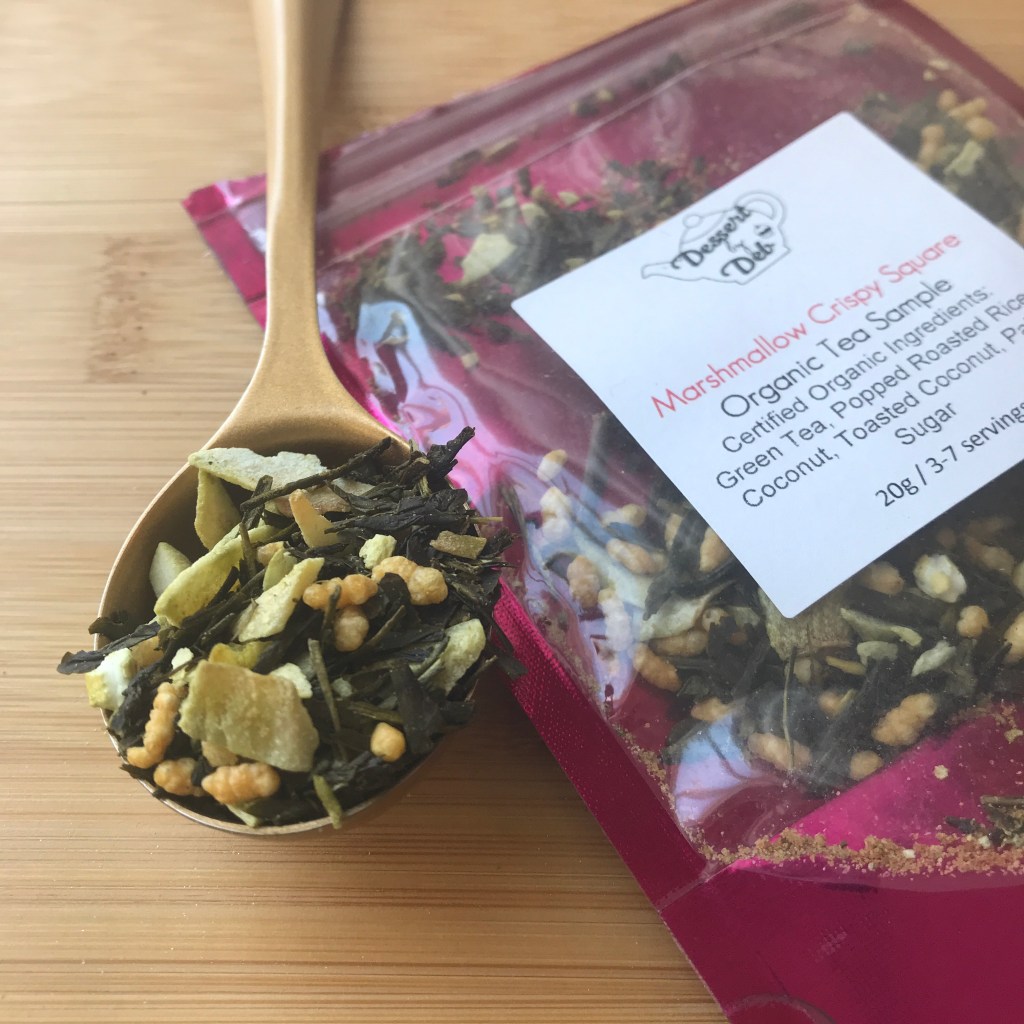
    The Marshmallow Crispy Square blend appears to have broken pieces of green tea, large pieces of coconut flakes, pieces of brown rice– some of which have popped open into what looks like popcorn– and a dusting of brown sugar. The vegetal scent of the dry green tea cuts through coconut and sugar sweetness. After steeping, the tea produces a cloudy, yellow liquor that smells sweet and coconutty with this slightest hint of roasted rice.

    I’m usually reluctant to sip flavored green teas, but I make exceptions for Genmaicha (a Japanese green tea with roasted rice) and coconut-flavored green teas. Dessert by Deb’s Marshmallow Crispy Square blend was a perfect marriage of both of these. The mouthfeel of the tea is thick and luscious. Coconut is in the forefront with hints of roasty toasty rice and vegetal green tea peeking through at the end of the sip. It is a perfect balance of sweet and savory that I will look forward to dipping in to all year long, although the flavor profile makes me think of Springtime when the sun is warm and golden but there is still a chill in the breeze.

    Coconut Maple Custard

    The Coconut Maple Custard blend appears to have small, broken pieces of black tea and small chips of coconut that have been dusted with palm sugar. There are also biscuit-colored chunks of what I think is maple or maple sugar. The blend smells sweet and like coconut, and it steeps to a burned orange color with slicks of oil on the surface from the coconut.

    I enjoyed the Coconut Maple Custard, but I didn’t taste the flavor profile Dessert by Deb was trying to convey. Most maple-flavored teas do not actually taste anything like the flavor I associate with “maple”. I assume this is because I was raised on Aunt Jemima, which is artificially flavored “maple” syrup. Instead, this blend was a light black tea with a hint of coconut and sugary sweetness on the finish, but it was pleasant to drink, nevertheless.

    Orange Creamsicle Mousse

    The Orange Creamsicle Mousse blend appears to be small chips of red rooibos and coconut, chunks of orange peel, and short sections of green lemongrass. The blend smells like sweet orange, woody, and slightly medicinal, and it steeps to a rich orange color.

    Prior to the Orange Creamsicle Mousse from Dessert by Deb, I have had very negative experiences with any orange rooibos blends that accidentally crossed the threshold into my house. It’s a flavor combination that runs the risk of tasting like cough medicine since orange is a common flavor used in children’s medicine (at least in the U.S.), and rooibos occasionally offers medicinal aromas. But, there is something special about this blend, and I think it’s because it relies on natural ingredients instead of artificial or natural flavoring. The orange pieces and orange peel in this blend offer a soft, juicy orange flavor that compliments the woody rooibos. The addition of the lemongrass builds on the citrus element, too. The cream element, relying mostly on coconut pieces, is subtle but helps create one of the more successful orange creamsicle blends I’ve tried so far. And thankfully, my palate did not discern any medicinal aromas from the rooibos.

    Overall, my initial experience with Dessert by Deb has been a treat! I think what impresses me the most is the blends captured the essence of the desserts they were inspired by without relying on massive ingredient lists and artificial flavoring. They are fun and creative and well worth exploring if you’re a fan of dessert teas (like myself!).

    If you’ve tried Dessert by Deb, let me know about your favorite blends in the comments! Or, if you haven’t tried Dessert by Deb, let me know what your favorite dessert blends are.

    Already tried these Dessert by Deb blends? Check out these tasTEA recommendations:

  • I Failed Adagio’s communiTEA

    I Failed Adagio’s communiTEA

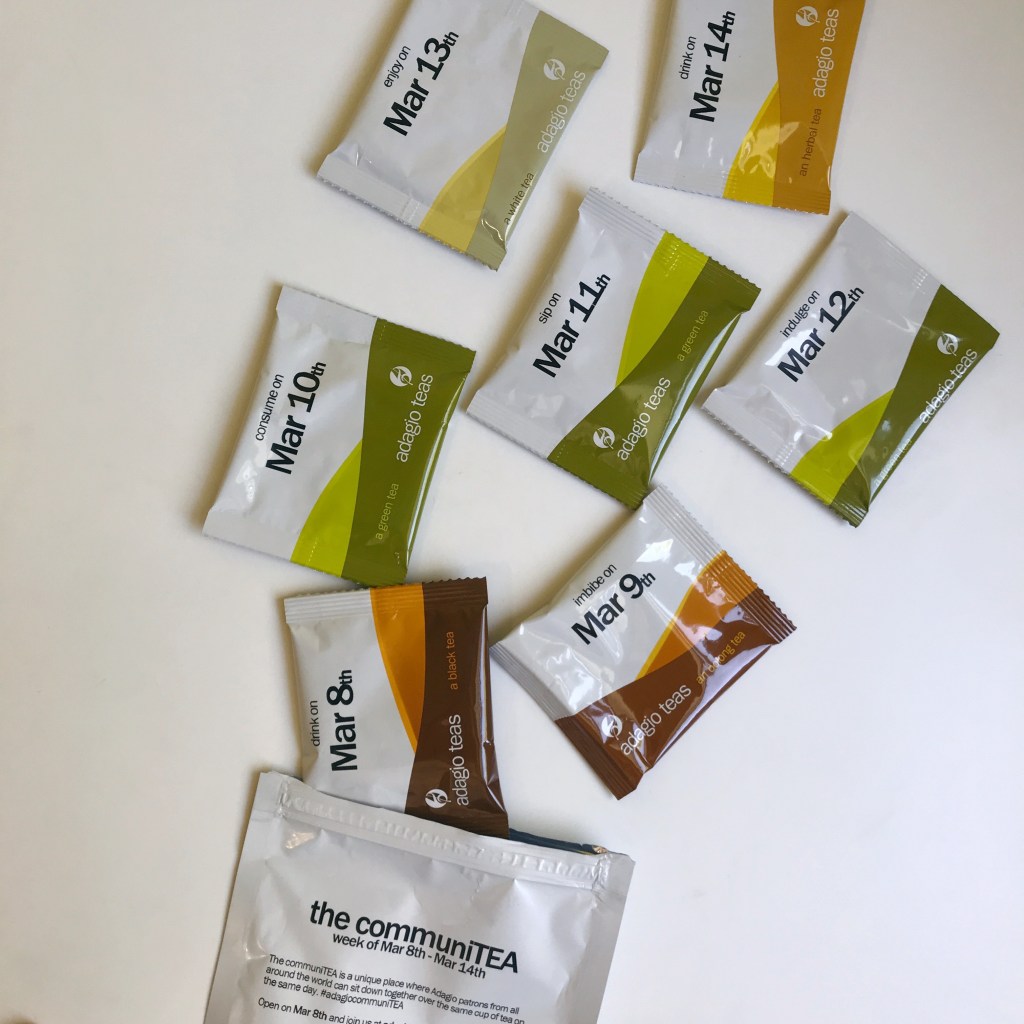
    While re-organizing my tea cabinet last week, I discovered a bag of communiTEA teas from Adagio Teas. It was dated the week of March 8th through March 14th, and each single-serving packet within was still sealed shut. I remembered I kept putting it aside with the intent to film YouTube videos or take Instagram glamour shots because if a tea is not showcased across social media, was it even consumed? The goal of the CommuniTEA is to bring people together over the same cup of tea on the same day, and I did not show up. I just never made the time for it.

    I’ve written and talked about how drinking tea is a lesson in being present and in mindfulness. Yet, I never address how it always seems to be at odds against my blogging and vlogging hobby and how both tend to take me out of the moment. I can’t begin to account for the times I’ve spilled tea all over the table because I was more focused on photographing the silhouette of tea pouring from a gaiwan. Or the times I struggled to get through advent calendars or countdown boxes timely because filming and editing videos is really time-consuming.

    And despite my awareness of this problem, instead of taking a few moments just to myself to enjoy a cup of tea…I spent the past two days binge-drinking communiTEA teas, taking pictures, and typing up this blog post. #NOREGRETS


    March 8 – Currant Tea

    I am a sucker for Adagio Teas’s creative blends, like the new Honeybush Blueberry Pancake. Have you seen my video, where I rave about it? But, I am equally in love with their simple, fruit-flavored black tea blends. The Orange Black Tea from Adagio Teas is a favorite of mine, and now the Currant Tea from March 8 was love at first sip, too. Adagio Teas’s Currant Tea is a blend of black tea, natural currant flavor, and raspberry flavor. I can’t recall the flavor of currants, but this blend offers a brisk and slightly malty-sweet black tea base that is complimented by red berry flavor. I’ve never been particularly inspired to make my own tea blends before, but I couldn’t help but wonder how the Currant Tea would taste blended with cream and zesty lemon flavors. I might be exploring Adagio’s Signature Blends soon…

    March 9 – Formosa Oolong

    When I first started sipping the Formosa Oolong, I was fairly indifferent about it. By the end of the cup though, it had me longing for brisk October mornings. This week’s heat-wave also makes me wish October was already here, but I digress. This tea tastes slightly toasty and definitely like crunchy Autumn leaves. The Adagio Teas website mentions there are some fruity notes in this tea, but I didn’t notice them. It’s possible I may have been able to draw them out using a different steeping method.

    March 10 – Serenitea

    The Serenitea blend is a fandom tea blended by Amy Zen. It is inspired by the science fiction series Firefly, and it is a blend of Spearmint, Gunpowder Green Tea, Black Tea, and Hazelnut flavoring. It’s an interesting twist on a Moroccan Mint because of the subtle hazelnuttiness. Also, and I feel like I lose a lot of nerd credit for admitting this, I have never watched Firefly beyond the pilot episode, so I have no idea if this blend captures the essence of the series. (Also, I may have forgotten to take a picture of the tea after I steeped it…)

    March 11 – Speedy Recovery

    I tend to stay away from blends that are for wellness or health purposes because I can’t not imagine the tea tasting medicinal. Even teas like Speedy Recovery, which is a blend of Green Tea, Peppermint Leaves, Ginger, Licorice, Cardamom, Fennel, Marigold Flowers, Black Peppercorn & Cloves starts to sound unappealing even though I appreciate all the ingredients except licorice. The flavor of green tea takes a backseat allowing the peppermint, ginger, and fennel shine in this blend. While it has challenged my perception of wellness teas, I still won’t reach for this one during the winter months. I take advantage of my stuffed up nose to power through all the teas I’m avoiding drinking!

    March 12 – Apricot Green

    Apricot Green from Adagio Teas is a blend of Green Tea, Apple Pieces, Natural Apricot Flavor, Apricots & Marigold Flowers, and I suppose of all the days during my communiTEA week, this was the tea I looked forward to the least. I’m not in love with flavored green teas, and I am not in love with Adagio’s peach or apricot flavoring. Yet, I found myself pleasantly surprised by the Apricot Green. I opted to sweeten this tea with sugar and serve it over ice, which helped to tone down the vegetal and steamed vegetable quality of the green tea used in this blend and allowed for the juicy apricot flavor to pop. This turned in to the kind of tea I could drink buckets of on a hot, summer day.

    March 13 – White Strawberry

    I may have also grumbled when I saw the packet of flavored white tea in my communiTEA week because white teas and I don’t get along. But you know what? I kind of fell in love with the blend from March 13. Within the packet was White Strawberry, which is a blend of White Tea, Rooibos Tea, Apple Pieces, Blueberries, Hibiscus, Natural Strawberry Flavor, Strawberries, Rose Petals, Blue Cornflowers & Natural Vanilla Flavor. This tea was juicy strawberries, sweet vanilla pound cake, and the most luscious, silky, and thick mouthfeel. It was basically strawberry shortcake in a cup. Would I get this again? Yea…yea, I think I would!

    March 14 – Sweet Science

    Sweet Science is another fandom tea, and this one is blended by Lisa & Kat Miller. This tea is inspired by Princess Bubblegum from Adventure Time, and it is a blend of Rooibos Tea, Black Tea, Apple Pieces, Rose Hips, Hibiscus, Marigold Flowers, Natural Peach Flavor, Coconut, Natural Creme Flavor, Natural Pineapple Flavor, Natural Coconut Flavor, Pineapple Pieces & Apricots. While I enjoyed this blend, sipping from such a small sample almost ensures that I do not get the full range of flavor this blend was trying to accomplish. I taste tropical fruit-flavored rooibos, but I’m missing the creamy notes from the coconut and creme flavors.


    If you’re interested in learning more about the kinds of teas Adagio’s newest subscription service offers, be sure to check out my first post on the communiTEA. A YouTube playlist of my reviews on some of the teas I’ve tried so far, is also posted there. Also be sure to check out the Adagio Teas CommuniTEA page to find out what other tea drinkers think!

  • Gyokuro from Japanese Green Tea Co.

    Gyokuro from Japanese Green Tea Co.

    I really enjoy my mugs of delicious, flavored teas and tisanes. I will always reach for a Hot Cinnamon Spice when winter settles in. I will happily chug honeybush dessert teas that taste like banana nut bread and cotton candy. And of course, how could I not indulge in a spiced chai latte when visiting coffee shops? But, the kind of tea I love most of all? Those unflavored, single origin teas that demand slow, intentional sips so I don’t miss a note in its array of aromas. Those teas that transform across multiple infusions, and I can’t help but scribble barely legible tasting notes because I’m too excited to explore a tea to care about neatness. Those teas that transport me to a time and place that isn’t now, but instead some distant memory. Some as clear as day, others a bit muddled– possibly an amalgamation of memories, but whatever it was, brought joy and wonder. I experienced all of that recently while sipping a Gyokuro from Japanese Green Tea Company.

    The first sips are savory umami. They are sultry summer afternoons in north Georgia, where the heat index is 108. Humidity hangs heavy in the air and thunderheads grow in the sky, but I am outside anyway seeking refuge in the woods behind my house where I can follow the creek and the shade of the tall, skinny pine trees all the way down to the shore of Lake Allatoona. I don’t meander to the lake very often, but when I do, there is a humming in my chest and my legs– a sensation of being thrilled because I’ve ventured somewhere I’m not supposed to be.

    The finish is slightly sweet and grassy, and now it’s no longer sultry summer afternoons. It is a late Spring morning instead. It is soft, freshly mowed grass clippings– the kind that sticks to bare feet eager to run to the park to spend the afternoon poolside. It is a fist full of quarters for the vending machine. It is pool toys teetering out of over-stuffed tote bags. It is sitting impatiently at the edge of the deep end until adult swim is over. It is somersaulting into the pool the moment the whistle is blown.

    The second cup takes me someplace entirely different. It’s further back on my timeline and further north, too. Only the best teas take me here– back to central Ohio, back to my foolhardiest days. The second cup has lost most of the umami and is instead mostly sweet and vegetal. It is listless summer afternoons, chewing on the end of tall, tasseled grass on the front porch of the babysitter’s house. The kind with seeds we plucked off and stuck on our tongues, and when we said “caterpillar, caterpillar, caterpillar”, the seed would inch its way to the back of the mouth.

    The Gyokuro from Japanese Green Tea Co. feels like a luxury both in aroma and experience– one I want to indulge in all the time but through sheer willpower, manage to save for the rare quiet moments when Jon and Oliver are snoozing and I can just sit and exist and reflect.

    This tea was sent to me for free in exchange for a review. Thoughts are ever my own. If you are interested in learning more about Japanese Green Tea Co. and Gyokuro, or you like your tasting notes a little more concrete, be sure to check the video at the top of the post. You can also check out my review for their Fukamushi Sencha!

  • Jasmine Pearls from Adagio Teas

    Jasmine Pearls from Adagio Teas

    I have searched for a tea tasting journal for the past few years, but I never found exactly what I was looking for; so, I have been writing in whatever journal I had sitting around. Notes are scattered throughout four different journals, which are now tucked under odd places, like the couch, in Oliver’s toy basket, under the bed– anywhere Oliver manages to fling them, really. Finally, I decided on a new home–a trusty, 98 cent Composition notebook, that I now keep well out of Oliver’s reach!

    Last weekend, I sipped Jasmine Pearls from Adagio Teas. I don’t know what made me grab this particular tea. It’s not one I typically drink, and it was only in my collection because it came in my Christmas advent calendar. I have avoided it because Oliver’s pediatrician mentioned jasmine teas (and mint teas) could have negative impacts on a nursing mother’s milk supply, but now that Oliver is eating solids foods as well now, I have become less restrictive.

    Aside from that, jasmine just isn’t a flavor I appreciate. I like some floral flavors, like rose, but I think jasmine can make tea taste like perfume or quite bitter. Still, I sipped on.

    The tea was dark green leaves, scented with jasmine, and they were wound tightly into little balls reminiscent of a pearl. They came in a tea bag, though the Jasmine Phoenix Dragon Pearls seem comparable if you want a loose leaf variety. I decided to cut open the tea bag, so I could brew the pearls loose, and what a smart decision that was because these pearls unfurled into full, big tea leaves that could be steeped multiple times.

    The initial steep had the most prominent jasmine flavor followed by a slight sweetness from the green tea. The following steeps lost the sweetness from green tea, but the jasmine seemed to mellow. Overall, I thought this tea had a nice, balanced flavor– never perfume-like and never bitter. I steeped this three times, but I think I could have steeped this a fourth and possibly even a fifth, which surprised me considering this started in a teabag!

    Where do you record your tea tasting notes? Do you keep a pen and paper journal, or do you record everything digitally?

    Looking for teas with floral notes? Check out these tasTEA recommendations:

  • Chili Lime Coconut Green from Adagio Teas

    Chili Lime Coconut Green from Adagio Teas

    Are you looking for a little adventure in your cup of tea? Then check out the new Chili Lime Coconut Green from Adagio Teas. It will make your skull sweat!

    Adagio’s Chili Lime Coconut Green is a blend of green tea, chili pepper, lemon grass, apple pieces, coconut, orange, key lime pie flavor, safflower, and natural coconut flavor

    I went into this experience not really knowing what to expect. I’ve certainly had savory green teas before, like a gen maicha or a sencha. But with the citrus flavors, the apple, and the coconut in this blend, I thought this was going to be a sweet and spicy tea. I was very, very wrong, so when expectations and reality didn’t match, it affected my first experience with this tea. That is to say, “I was happy to try it, but I wouldn’t be quick to drink it again”. I am happy to say, this tea is growing on me.

    Adagio’s Chili Lime Green Tea is very much a savory tea– one very reminiscent of a green curry because of the coconut, lemongrass, chili flakes, and lime flavoring. And luckily for me, that’s my favorite kind of curry!

    The most prominent flavor in the Chili Lime Coconut Green is the creamy coconut, and of course the spice from the chili flakes will catch you in the back of the throat each sip. This tea is definitely spicy, but it’s not a spice that lingers. Finishing notes are bright citrus flavors, especially lime, which brings a brightness and acidity to balance out this blend. The Adagio Teas website mentions that the coconut offers a sweetness to finish rounding out the cup, but I’m not picking that up as I sip.

    The Chili Lime Coconut Green isn’t an everyday drink, but it is a fun way to spice up the afternoons! (See what I did there?)

    Have you ever tried a spicy tea before?

    If you can’t handle the spice, check out this tea instead:

  • The First Day of Spring with Chunmee Green Tea

    The First Day of Spring with Chunmee Green Tea

    How appropriate that I should upload a video and publish a blog post about a delicious tea that resonates Springtime on the first day of Spring? I didn’t even plan this. I don’t even think I’m that clever anymore. Of course, it’s only March, which means Michiganders are still weeks away from consistently pleasant weather and pink and white blossoms budding on trees, but at least the sun has started to poke through Winter’s cloudy days. That’s a start. In the meantime, there is Made of Tea’s Chunmee Green Tea to sip on while we wait. It has an aroma that reminds me of freshly cut hay, which makes me antsy for warmer weather so I can spend some time outdoors.

    I don’t think I’ve looked forward to Springtime so fiercely before. Between working from home and having a little guy all cooped up indoors, I can’t wait for weather warm enough for strolls at the park. Here are 6 other things I want to do this Spring:

    1. Re-do the kitchen; liven it up with fresh paint, replace light fixtures, buy a kitchen table finally…
    2. Try my hand at growing a little tea garden in my backyard, again
    3. Learn how to mow the lawn so Jon and I don’t battle over the yard anymore
    4. Clean up and re-mulch the flower beds in the front yard, so our house has a little more curb appeal
    5. Get back in to shape. I’m basically a loaf of Brioche at this point
    6. Giving my home the Marie Kondo treatment. Seriously, when did I accumulate so much stuff?

    What is springtime like in your neck of the woods, and what are you looking forward to doing?

    Looking for more teas to sip this Springtime? Check out these:

  • Gardens & Green Tea

    Gardens & Green Tea

    There is something overwhelming about Springtime. I’m sure I bring it on myself after six months of hibernation, but the rate at which tasks are added to my To Do List makes me withdraw from the world. Thankfully, family came for a visit, and I was wrenched from my comfort zone (lately known as “the couch”) and thrown into the yard. Up until this, our house had been an embarrassment with overgrown bushes and trees and weeds in the flower bed that reached my knees (okay, really it was mid-thigh). Yesterday we spent 12 hours pulling weeds, mulching the flower bed, potting herbs (for tea! such as spearmint, lemon balm, and bee balm) and tomatoes and planting hastas, cutting back bushes and trees, mowing the lawn, whipping the weeds, and cleaning and replacing gutters. Today, my muscles are sore and my skin is sunburned, and I feel proud of what was accomplished yesterday.

    Today I’m taking things much more slowly. I read out on the deck to catch some morning sun; although apparently 67 degrees is “scorching hot” to me, so I only lasted about an hour. Now I’m appreciating the view of my front window– of mammoth trees, petunias, and a snoozing kitty, while sipping green tea and waiting for the afternoon’s impending thunderstorms. (Yes, I know my curtains are ugly. They came with the house, and I haven’t replaced them yet).

    Today’s tea comes from Japanese Green Tea IN, a tea seller specializing in green tea from Japan’s Shizuoka prefecture (which I understand has an incredible view of Mount Fuji!). I tried their Fukamushi Sencha, first crop, which is unlike any tea I’ve ever experienced before. The appearance of the tea leaves was the first surprise. The forest green leaves varied in size including long thin leaves, small fragments, and even powder. The fragments and the powder first led me to believe that this was a reflection of the quality of the tea– that it was no different from a bag of Lipton tea dust, but I was mistaken. This appearance is a result of how the tea is processed– the tea is deep steamed, and while the leaves become more delicate (hence the breakage), the astringency is reduced and the flavor becomes more rich.

    The next surprising characteristic about this tea was the color. Most of the green teas I’ve steeped produce a pale yellow liquid, but the Fukamushi Sencha produced a cloudy, Chartreuse green color. I was intimidated at first, thinking I over-steeped my tea, but again, I learned this is just another characteristic of this kind of tea. It’s also common to have tea sediment collect at the bottom of the mug– go ahead and drink that up though because they are nutrient-rich!

    As for the flavor of the tea, I was under the impression it was supposed to be naturally sweet, but it tasted more savory to me. The first steep was vegetal and lightly astringent, and the finishing notes were buttery and slightly like blanched or grilled asparagus. Because it’s a savory tea, and also because it is lightly caffeinated, I think it makes for a perfect early afternoon treat. The tea also begs for multiple infusions. So far, I’ve brewed four cups of tea with the same batch of tea leaves, and the flavor (although lacking the buttery finishing note) was just as rich and flavorful as the first cup, and I’m confident I can steep at least one or two more cups.

    The final notable characteristic of this tea is how it is farmed. Japanese Green Tea IN sells tea that is cultivated using the Chagusaba Method. The tea farmers in the Shizuoka prefecture put sustainability first, and as a result, the region has been named 1 of the 26 sites in all of Asia and the Pacific Islands as a Globally Important Agricultural Heritage System by the Food and Agriculture Organization of the United Nations. The Chagusaba Method uses deliberately grown, surrounding grasslands to mulch fields of tea shrubs. The grass mulch prevents weeds, keeps the tea fertilized, prevents run-off into surrounding ecosystems, and maintains biodiversity. The Chagusaba Method is a labor-intensive process, which means it is a dying art in a business world that is becoming increasingly mechanized to remain competitive in a global market.

    Japanese Green Tea IN’s Fukamushi Sencha is probably one of the more expensive teas I’ve featured on Books & Tea; it’s a little bit of a splurge at $45 for 3.5oz (that’s about 30-40 cups). That breaks down to about $1.12 per cup (compared to Adagio’s 78 cents/cup and Twinings 20 cents/cup). But the quality of this tea though… the flavor, the multiple infusions, the sustainability… is a worthwhile luxury for novice to seasoned tea drinkers alike.

    A sample of this tea was provided for free in exchange for an honest review.

    Save

  • Lemon Meringue Green Tea is the Cat’s Meow

    Lemon Meringue Green Tea is the Cat’s Meow

    You probably won’t believe me when I say I’m not that keen on lemon-flavored anything. Not after I baked that delicious Lemon Loaf Cake inspired by the Memory of Lemon by Judith Fertig. And definitely not after I raved about Lemon Soleil Tea from Adagio Tea. I’m not even sure I believe it myself, especially not after sipping Adagio Tea’s Lemon Meringue Green Tea. In fact, I can say with a certain degree of confidence that I am most definitely in denial about my love for lemon-flavored treats.

    Adagio’s Lemon Meringue Green Tea is a blend of green tea, apple pieces, orange peels, natural lemon flavor, marigold flowers, natural vanilla flavor, and natural creme flavor. Upon opening the pouch, I’m greeted by the zesty and sugary-sweet scent of the blend, which reminds me of both a box of Lemonheads and a box of Fruit Loops. But don’t let that intimidate you because the flavor of the tea is actually quite mellow compared to the scent of the dry leaves.

    I first enjoyed this tea hot and plain. I did not really taste the green tea as much as I would have expected, and yet I’m not actually disappointed by this. Instead, I taste bright citrus flavors with a subtle, undercurrent of creaminess (my spell check is trying to tell me that I meant to type “dreaminess”, which is kind of the same thing, right?). It’s the kind of tea I want to drink in February to remind me that world isn’t always freezing and dark as I stare mournfully out the window at mounds of snow and a sidewalk that was technically supposed to shoveled already according to the village ordinance.

    When this tea really shines though is iced and sweetened. Preferably sipped outside while reading a book on a perfect day like today– 77 degrees with a breeze, sunny, not a cloud in the sky. (Somebody pinch me! I must be dreaming!) It’s just like eating lemon meringue pie without the risk of over-indulging on too many slices. Plus, nobody judges you for going back for a second cup of tea, right?

    Adagio’s Lemon Meringue Green Tea appears to be a seasonal blend, so be sure to snag some before the end of springtime!

    A sample of Lemon Meringue Green Tea was provided by Adagio for free in exchange for an honest review.

  • Some Thoughts on Tea and the Changing of the Seasons

    Some Thoughts on Tea and the Changing of the Seasons

    There are two things I have realized after brewing myself a cup of Teavivre’s Lu Shan Yun Wu Green Tea. First, all tea from Teavivre require a certain kind of care when brewing– the temperature of the water and the length of time you allow the leaves to steep are important, unlike the Twinnings tea bags I so recklessly over-steep. Second, I’m nearly incapable of giving my tea leaves the amount of attention they so very much deserve. So, after steeping my Lu Shan Yun Wu into oblivion and bitterness, I had to promptly pour it out and try something else. The second time around, I tried Xin Yang Mao Jian Green Tea, and the results were much better.

    I am fascinated by the Xin Yang Mao Jian tea leaves. They are dark green, straight tipped, and ever-so delightfully fuzzy– a sign that the leaves were picked in early spring. The dried leaves smelled vegetal and even a bit like nori, the dried seaweed you might find wrapped around maki sushi. I thought the flavor of the tea itself would be overwhelmingly savory, but I was surprised when floral, smoky, sweet notes were more prominent to me. This tea is most refreshing and perfect for a late spring or early summer day when the skies are blue and delicate blossoms from tree branches flutter about in breezes and the sun is just starting to warm up the wintertime air.

    And as much as I enjoyed Xin Yang Mao Jian, I felt disconnected from it because I can feel Autumn right around the corner. Even though it is still August, the mornings this week can best be described as “brisk” and the days for the most part are gloomy and overcast; somehow the melancholy of this season invigorates me. Then, Friday evening I stood out on my balcony to enjoy the cheers of the high school students and their families as the drumline’s cadence sauntered down the road, and for a little while, I felt nostalgic for my marching band days. I cannot wait for Autumn to truly settle in.

    What is Autumn like where you live? Are you excited that the season is right around the corner?

    Samples provided by Teavivre in exchange for an honest review.