By Golly, Ollie!

💾 a blog about books, tea, & geekery

Tag: tea musings

Posts featuring tea tasting notes that usually meander through personal reflection

  • Alone Time and Yan Shan Mu Dan

    Alone Time and Yan Shan Mu Dan

    Alone time is fleeting these days. I have been trying to find the time to write about a tea I tasted last Sunday morning, and I finally found it on a Thursday night after everyone else went to bed. I penned this post by cellphone light– the candlelight of 2020. Oliver snored beside me, raindrops pattered on windows, thunder rumbled across the sky, and lightning flashes brightened a dark room. It was a different atmosphere compared to last Sunday morning.

    Last Sunday, I finally decided to explore a 2015 Yan Shan Mu Dan from Old Ways Tea Co.. It was an aged white tea that came in my Countdown to Summer Box from Tea Thoughts. That morning, I allowed myself some quiet, guilt-free time alone on the back porch while an episode of Sesame Street distracted Oliver. It was barely 7:00 in the morning. The sun rose over dew-covered lawns, and fog hung heavy in the humid air. Or, maybe it was leftover smoke from the fireworks from the night before. The only sounds were birds chirping in the trees surrounding my home, the hum of a neighbor’s air conditioning unit, and the quiet clinks of porcelain as I gently shook tea leaves in a warm gaiwan. The cup of warmed leaves offered a sweet and smoky fragrance, and the lid smelled like overripe fruit. The tea leaves looked like Autumn leaves covering the forest floor– muddy brown, pale yellow, sage, and sometimes when the sun hit the underbelly of the leaf just right, red Georgia clay.

    As I began brewing the first infusion, I wondered why I was even engaging in any sort of pomp and circumstance with this tea. It is rare for me to drink white tea and taste anything other than peppery hot water, so I was surprised when I tasted faint barbecue smoke and something that is sweet, sour, and vegetal all at once– like chewing the ends of tall prairie grass. Infusion number two excited me even more as I noticed a fruit I could not quite name along with sweet and spicy cinnamon. Infusion three was melon rind, but the mouthfeel was thick and luscious like silk scarves. Infusion four was like a mild but smoky Lapsang Souchong. Infusion five is when everything married together into one perfect honeyed-plum and smoky-cinnamon sip, and it hit me like, “Oh! this is why people like white tea”.

    My tasting notes ended there because infusion six triggers a memory of my first apartment with Jon. In that memory, it is Autumn. It is always Autumn at that apartment even though Jon and I lived there for two years. It reminds me of Saturday mornings when Jon would be at work, and I would spend the morning picking out too many books at the library. I knew I would never read them all, but having a stack of new books close by always brought me comfort. Afterward, I would go to the grocery store and pick up soup and a deli sandwich for lunch. Then, I would go home, prepare a cup of tea, light a candle that smelled like caramel apples, and document my library loot because back then, this little space was a book blog called Books & Tea. Jon would meander in a short while later, crack open a Bell’s Two Hearted IPA, and sink into the couch to watch football, while I would cuddle down under blankets to read a cozy mystery novel.

    It was an unexpected memory. I still cannot figure out what fragrance or taste triggered it, but it was welcome nonetheless. And, the Yan Shan Mu Dan from Old Ways Tea gave me yet another positive experience with a white tea. It makes me feel optimistic about future white teas that my come into my collection.

    Have you been able to indulge in some rejuvenating alone time lately? Tell me about it in the comments!

  • I Failed Adagio’s communiTEA

    I Failed Adagio’s communiTEA

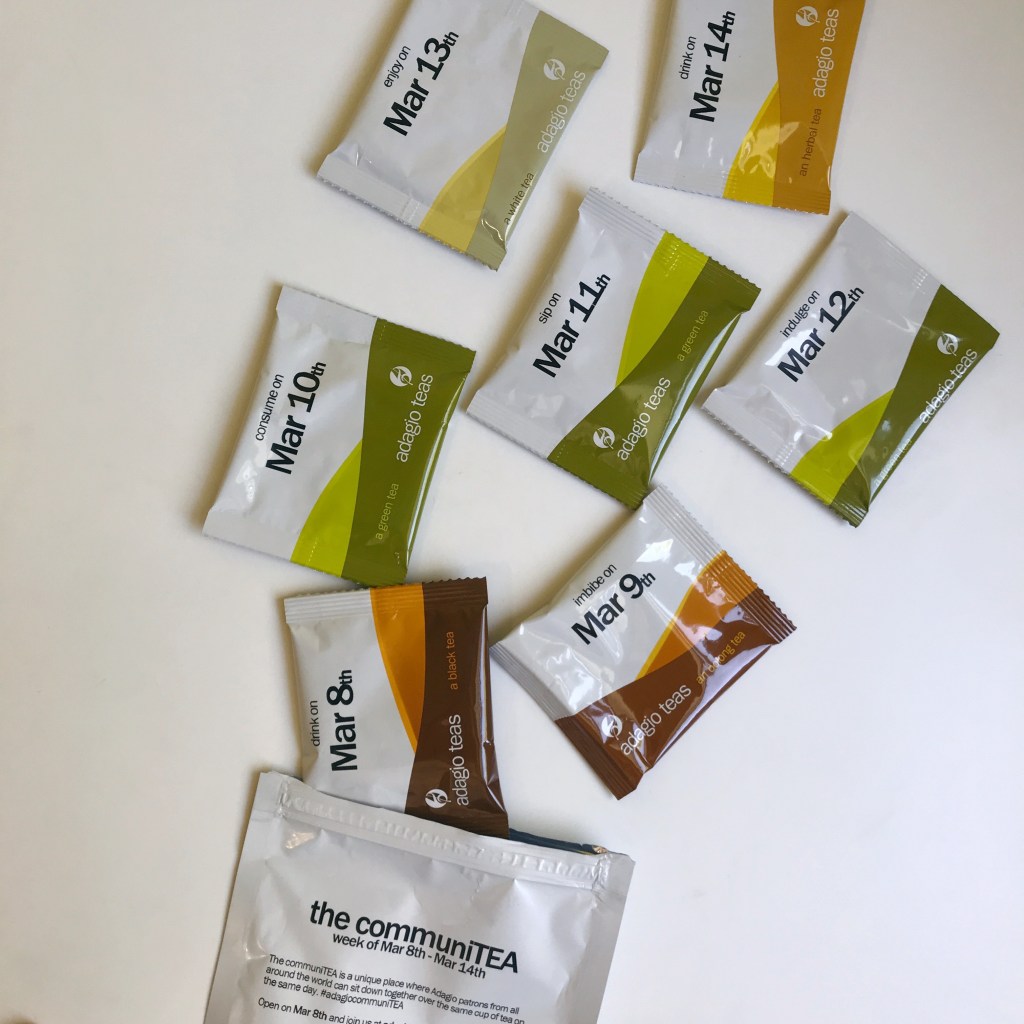
    While re-organizing my tea cabinet last week, I discovered a bag of communiTEA teas from Adagio Teas. It was dated the week of March 8th through March 14th, and each single-serving packet within was still sealed shut. I remembered I kept putting it aside with the intent to film YouTube videos or take Instagram glamour shots because if a tea is not showcased across social media, was it even consumed? The goal of the CommuniTEA is to bring people together over the same cup of tea on the same day, and I did not show up. I just never made the time for it.

    I’ve written and talked about how drinking tea is a lesson in being present and in mindfulness. Yet, I never address how it always seems to be at odds against my blogging and vlogging hobby and how both tend to take me out of the moment. I can’t begin to account for the times I’ve spilled tea all over the table because I was more focused on photographing the silhouette of tea pouring from a gaiwan. Or the times I struggled to get through advent calendars or countdown boxes timely because filming and editing videos is really time-consuming.

    And despite my awareness of this problem, instead of taking a few moments just to myself to enjoy a cup of tea…I spent the past two days binge-drinking communiTEA teas, taking pictures, and typing up this blog post. #NOREGRETS


    March 8 – Currant Tea

    I am a sucker for Adagio Teas’s creative blends, like the new Honeybush Blueberry Pancake. Have you seen my video, where I rave about it? But, I am equally in love with their simple, fruit-flavored black tea blends. The Orange Black Tea from Adagio Teas is a favorite of mine, and now the Currant Tea from March 8 was love at first sip, too. Adagio Teas’s Currant Tea is a blend of black tea, natural currant flavor, and raspberry flavor. I can’t recall the flavor of currants, but this blend offers a brisk and slightly malty-sweet black tea base that is complimented by red berry flavor. I’ve never been particularly inspired to make my own tea blends before, but I couldn’t help but wonder how the Currant Tea would taste blended with cream and zesty lemon flavors. I might be exploring Adagio’s Signature Blends soon…

    March 9 – Formosa Oolong

    When I first started sipping the Formosa Oolong, I was fairly indifferent about it. By the end of the cup though, it had me longing for brisk October mornings. This week’s heat-wave also makes me wish October was already here, but I digress. This tea tastes slightly toasty and definitely like crunchy Autumn leaves. The Adagio Teas website mentions there are some fruity notes in this tea, but I didn’t notice them. It’s possible I may have been able to draw them out using a different steeping method.

    March 10 – Serenitea

    The Serenitea blend is a fandom tea blended by Amy Zen. It is inspired by the science fiction series Firefly, and it is a blend of Spearmint, Gunpowder Green Tea, Black Tea, and Hazelnut flavoring. It’s an interesting twist on a Moroccan Mint because of the subtle hazelnuttiness. Also, and I feel like I lose a lot of nerd credit for admitting this, I have never watched Firefly beyond the pilot episode, so I have no idea if this blend captures the essence of the series. (Also, I may have forgotten to take a picture of the tea after I steeped it…)

    March 11 – Speedy Recovery

    I tend to stay away from blends that are for wellness or health purposes because I can’t not imagine the tea tasting medicinal. Even teas like Speedy Recovery, which is a blend of Green Tea, Peppermint Leaves, Ginger, Licorice, Cardamom, Fennel, Marigold Flowers, Black Peppercorn & Cloves starts to sound unappealing even though I appreciate all the ingredients except licorice. The flavor of green tea takes a backseat allowing the peppermint, ginger, and fennel shine in this blend. While it has challenged my perception of wellness teas, I still won’t reach for this one during the winter months. I take advantage of my stuffed up nose to power through all the teas I’m avoiding drinking!

    March 12 – Apricot Green

    Apricot Green from Adagio Teas is a blend of Green Tea, Apple Pieces, Natural Apricot Flavor, Apricots & Marigold Flowers, and I suppose of all the days during my communiTEA week, this was the tea I looked forward to the least. I’m not in love with flavored green teas, and I am not in love with Adagio’s peach or apricot flavoring. Yet, I found myself pleasantly surprised by the Apricot Green. I opted to sweeten this tea with sugar and serve it over ice, which helped to tone down the vegetal and steamed vegetable quality of the green tea used in this blend and allowed for the juicy apricot flavor to pop. This turned in to the kind of tea I could drink buckets of on a hot, summer day.

    March 13 – White Strawberry

    I may have also grumbled when I saw the packet of flavored white tea in my communiTEA week because white teas and I don’t get along. But you know what? I kind of fell in love with the blend from March 13. Within the packet was White Strawberry, which is a blend of White Tea, Rooibos Tea, Apple Pieces, Blueberries, Hibiscus, Natural Strawberry Flavor, Strawberries, Rose Petals, Blue Cornflowers & Natural Vanilla Flavor. This tea was juicy strawberries, sweet vanilla pound cake, and the most luscious, silky, and thick mouthfeel. It was basically strawberry shortcake in a cup. Would I get this again? Yea…yea, I think I would!

    March 14 – Sweet Science

    Sweet Science is another fandom tea, and this one is blended by Lisa & Kat Miller. This tea is inspired by Princess Bubblegum from Adventure Time, and it is a blend of Rooibos Tea, Black Tea, Apple Pieces, Rose Hips, Hibiscus, Marigold Flowers, Natural Peach Flavor, Coconut, Natural Creme Flavor, Natural Pineapple Flavor, Natural Coconut Flavor, Pineapple Pieces & Apricots. While I enjoyed this blend, sipping from such a small sample almost ensures that I do not get the full range of flavor this blend was trying to accomplish. I taste tropical fruit-flavored rooibos, but I’m missing the creamy notes from the coconut and creme flavors.


    If you’re interested in learning more about the kinds of teas Adagio’s newest subscription service offers, be sure to check out my first post on the communiTEA. A YouTube playlist of my reviews on some of the teas I’ve tried so far, is also posted there. Also be sure to check out the Adagio Teas CommuniTEA page to find out what other tea drinkers think!

  • Ancient Tree Green Puerh from Masters Teas

    Ancient Tree Green Puerh from Masters Teas

    The one thing I know about Pu-erh tea is I don’t know much about Pu-erh tea. So, I made it one of my resolutions to learn about it, taste it, explore it, and see if I could acquire a taste for it. My first experience with pu-erh was a flavored one, and it didn’t go very well (I’m looking at you, S’mores Chai). In my defense, I didn’t intend to drink a flavored pu-erh; I’m not entirely sure I realized S’mores Chai had a pu-erh base when I purchased it. But, I digress.

    My second experience with puerh, the one I’m sharing with you now, was entirely different. First, it was unflavored. Second, it was a sheng puerh instead of, and I’m assuming based on color and what I’ve read about the taste, a shou puerh.

    Also, in hindsight, I probably should have read a little more before diving into my first cup of sheng pu-erh, but sometimes it’s fun to go in blind, unaffected by expectations based on other peoples’ experiences. I guess it’s sort of like when I visit a new city for the first time. I like to wander around without direction just to get a sense of the place, and sometimes I even accidentally stumble upon something I didn’t know to look for. Like the doggy playdate in a park nestled between skyscrapers in Chicago. Or the pinball machines tucked at the back of Coast City Comics in Portland, Maine. Oh, but I digress again.

    Ancient Tree Green Puerh from Masters Teas
    Origin: Yunnan, China
    Elevation: 800m*
    Harvest: April 2019

    *elevation currently means nothing to me because I’m not knowledgeble about how that affects tea. Also, it’s in metric, which I haven’t used outside of 11th grade chemistry, and we definitely were not measuring anything in meters.

    The Masters Teas website goes on to explain that the tea was hand-plucked from 150-year old trees (which don’t really sound that ancient), and this pu-erh goes through a 10 minute firing followed by roasting for 5-6 hours.

    My tasting notes regarding temperatures and infusion times are inconsistently recorded. I’m going to say it is because I was meandering my way through this tea, much like the way I meander through cities without maps, but really I’m just bad at logging that information. I need to get better at that as I practice with my gaiwan.

    The dry leaf is tightly twisted two leaves and a bud. They are brown, spinach and pea green, and occasionally there is a leaf covered in soft, silver fuzz. Their fragrance reminds me of the greenhouse I worked at for a season back in college. It is the scent that would stick to my fingers after deadheading flowers– vegetal and sour but somewhere buried is a hint of sweetness.

    I put the dry leaf into a warm gaiwan and shake it. A new fragrance surfaces, and it smells sweet, powdery, and floral. Is it orange blossoms? Is it budding magnolias? It’s something that reminds me of Florida in February.

    After steeping, the wet leaf smells sour and like steamed vegetables. Wilted spinach and lemon came to mind, and I find myself reluctant to drink.

    Infusions 1 and 2

    The liquor is pale, golden yellow, and the aromas are earthy and vegetal although my novice tongue can’t point to anything more specific than that. There is an astringency that makes me salivate and a bitterness and sourness on the back of my tongue that makes me think about eating the skin from a purple plum.

    Infusion 3

    The liquor sits in the fill cup for a while as I try to process my first two infusions. I can’t tell if I steeped this incorrectly or if this is the nature of a sheng pu-erh, but while I sit there, notes of sweetness and “green”, like I’m chewing on leaves, linger on my tongue. When I finally tip the liquor out of the fill cup, the light bounces off it, and it looks like I’m pouring liquid sunshine into my cup.

    There is an energy in this infusion that I have never experienced before. My toes and cheeks are humming, and it feels like there is cotton in my ears and in the space between my eyes. I am so distracted by this that I forget to write down tasting notes.

    Infusions 4 and 5

    I took a break to take Oliver to the library and then to settle him down for a nap. But, when I return to the tea, I shut myself up in a bedroom for proper alone time. Infusions 4 and 5 are still pretty astringent but the earth and sour, vegetal aromas give way to something faintly like a sweet apricot.

    Infusions 6 to 8

    These final infusions were lovely, with infusion 6 being my favorite. The astringency has drifted away, and now all I taste are dried apricots. The finish is sweet, like I’m sucking on sugar cubes stolen from the tea tray during a Girl Scout meeting decades ago. The sensation stays with me quite some time after I have finished the tea.

    As I have no other sheng pu-erhs to compare this to, I can’t comment on quality and value. But, I suspect if you are new to this type of tea, like I am, Ancient Tree Green Pu-erh from Masters Teas is a good place to start. Adagio Teas and Masters Teas make better quality teas more accessible and inviting to those just starting on their tea journey. Even though I technically started my tea journey a decade ago, I let myself grow complacent and stagnant. I have learned more about tea in the past few months than I did during the past decade thanks to the wonderful tea community over on Instagram. And, it’s worth noting that the Ancient Tree Green Pu-erh from Masters Teas has made sheng pu-erh slightly less intimidating, which is good because I have a 2017 IPA from white2tea with my name on it.

    Thank you to Masters Teas for sending me a sample of this tea for free in exchange for a review.

    Looking for more about Masters Teas? Check out my thoughts on their Formosa Fancy Bai Hao and their Muzha Tie Guan Yin!

  • Gyokuro from Japanese Green Tea Co.

    Gyokuro from Japanese Green Tea Co.

    I really enjoy my mugs of delicious, flavored teas and tisanes. I will always reach for a Hot Cinnamon Spice when winter settles in. I will happily chug honeybush dessert teas that taste like banana nut bread and cotton candy. And of course, how could I not indulge in a spiced chai latte when visiting coffee shops? But, the kind of tea I love most of all? Those unflavored, single origin teas that demand slow, intentional sips so I don’t miss a note in its array of aromas. Those teas that transform across multiple infusions, and I can’t help but scribble barely legible tasting notes because I’m too excited to explore a tea to care about neatness. Those teas that transport me to a time and place that isn’t now, but instead some distant memory. Some as clear as day, others a bit muddled– possibly an amalgamation of memories, but whatever it was, brought joy and wonder. I experienced all of that recently while sipping a Gyokuro from Japanese Green Tea Company.

    The first sips are savory umami. They are sultry summer afternoons in north Georgia, where the heat index is 108. Humidity hangs heavy in the air and thunderheads grow in the sky, but I am outside anyway seeking refuge in the woods behind my house where I can follow the creek and the shade of the tall, skinny pine trees all the way down to the shore of Lake Allatoona. I don’t meander to the lake very often, but when I do, there is a humming in my chest and my legs– a sensation of being thrilled because I’ve ventured somewhere I’m not supposed to be.

    The finish is slightly sweet and grassy, and now it’s no longer sultry summer afternoons. It is a late Spring morning instead. It is soft, freshly mowed grass clippings– the kind that sticks to bare feet eager to run to the park to spend the afternoon poolside. It is a fist full of quarters for the vending machine. It is pool toys teetering out of over-stuffed tote bags. It is sitting impatiently at the edge of the deep end until adult swim is over. It is somersaulting into the pool the moment the whistle is blown.

    The second cup takes me someplace entirely different. It’s further back on my timeline and further north, too. Only the best teas take me here– back to central Ohio, back to my foolhardiest days. The second cup has lost most of the umami and is instead mostly sweet and vegetal. It is listless summer afternoons, chewing on the end of tall, tasseled grass on the front porch of the babysitter’s house. The kind with seeds we plucked off and stuck on our tongues, and when we said “caterpillar, caterpillar, caterpillar”, the seed would inch its way to the back of the mouth.

    The Gyokuro from Japanese Green Tea Co. feels like a luxury both in aroma and experience– one I want to indulge in all the time but through sheer willpower, manage to save for the rare quiet moments when Jon and Oliver are snoozing and I can just sit and exist and reflect.

    This tea was sent to me for free in exchange for a review. Thoughts are ever my own. If you are interested in learning more about Japanese Green Tea Co. and Gyokuro, or you like your tasting notes a little more concrete, be sure to check the video at the top of the post. You can also check out my review for their Fukamushi Sencha!

  • Back to Hogwarts with THE BOY WHO…tea from Adagio Teas

    Back to Hogwarts with THE BOY WHO…tea from Adagio Teas

    It’s September 1st, which means the Hogwarts Express departed without fail from Platform Nine and Three Quarters today. I can’t help but reflect on how this magical story has been in my life for TWENTY years, now. I never could have suspected the impact this series would have on me the day I pulled this book* randomly from one of the shelves at Walden Books. I held it in my hands, staring at the artwork almost debating whether to spend my allowance money on it or not. A mother passed by me, and seeing the book in my hands, told me the book I held was an incredible story. That was enough to convince me to bring it home with me, so thank you Random Mother who convinced me to buy Harry Potter back in 1999.

    *This book actually being Harry Potter and the Chamber of Secrets. My experience with book series back then was the Boxcar Children, Fear Street novels, and the Time Warp Trio. I had no idea there were series that were meant to be read in order!

    Today couldn’t be a more perfect Back-to-Hogwarts day here in Michigan either; 67 degrees, overcast, and occasionally drizzly. The perfect day to cozy up and enjoy the Harry Potter marathon on television while sipping THE BOY WHO…tea from Adagio Teas. THE BOY WHO… tea is one of the fandom teas blended by Cara McGee. It is a blend of Black Tea, Ginger, Cloves, Cardamom, Cinnamon, Natural Pumpkin Spice Flavor, Natural Caramel Flavor, Marigold Flowers & Natural Cinnamon Flavor.

    I can easily see black tea leaves, ginger pieces, cinnamon pieces, and cloves. I don’t see cardamom as I expected despite it being high on the ingredient list. The dry tea smells warm and inviting and most prominently of clove and cardamom.

    I brewed this tea a little differently this time. Typically, I would steep the tea leaves in hot water and then add milk and sugar, but this time I steeped the tea leaves directly in milk. I put two teaspoons of tea into one cup of milk in a saucepan, brought it to a boil, and then steeped for about 3-4 minutes. I added sugar to taste.

    I find that this tea isn’t as spicy as one would expect considering the ingredient list, and I’ve steeped it both in water and in milk. That being said, I still find this blend enjoyable and appropriate for Autumn. The black tea and the pumpkin flavor were the most prominent flavors, followed by cardamom and ginger. I much prefer steeping this tea in milk (as opposed to steeping in water and then adding milk). It adds a creaminess and mouthfeel that cannot be achieved if this tea were to be steeped in water. It has me reconsidering how I steep any of my spiced chais.

    Already tried THE BOY WHO…tea? Check out these other tasTEA recommendations:

    If you love Harry Potter, what is your favorite book from the series? For me, it’s hard to choose. It’s a toss-up between books 1, 3, and 5! It’s possible I love those three equally, albeit for different reasons.

  • Jasmine Pearls from Adagio Teas

    Jasmine Pearls from Adagio Teas

    I have searched for a tea tasting journal for the past few years, but I never found exactly what I was looking for; so, I have been writing in whatever journal I had sitting around. Notes are scattered throughout four different journals, which are now tucked under odd places, like the couch, in Oliver’s toy basket, under the bed– anywhere Oliver manages to fling them, really. Finally, I decided on a new home–a trusty, 98 cent Composition notebook, that I now keep well out of Oliver’s reach!

    Last weekend, I sipped Jasmine Pearls from Adagio Teas. I don’t know what made me grab this particular tea. It’s not one I typically drink, and it was only in my collection because it came in my Christmas advent calendar. I have avoided it because Oliver’s pediatrician mentioned jasmine teas (and mint teas) could have negative impacts on a nursing mother’s milk supply, but now that Oliver is eating solids foods as well now, I have become less restrictive.

    Aside from that, jasmine just isn’t a flavor I appreciate. I like some floral flavors, like rose, but I think jasmine can make tea taste like perfume or quite bitter. Still, I sipped on.

    The tea was dark green leaves, scented with jasmine, and they were wound tightly into little balls reminiscent of a pearl. They came in a tea bag, though the Jasmine Phoenix Dragon Pearls seem comparable if you want a loose leaf variety. I decided to cut open the tea bag, so I could brew the pearls loose, and what a smart decision that was because these pearls unfurled into full, big tea leaves that could be steeped multiple times.

    The initial steep had the most prominent jasmine flavor followed by a slight sweetness from the green tea. The following steeps lost the sweetness from green tea, but the jasmine seemed to mellow. Overall, I thought this tea had a nice, balanced flavor– never perfume-like and never bitter. I steeped this three times, but I think I could have steeped this a fourth and possibly even a fifth, which surprised me considering this started in a teabag!

    Where do you record your tea tasting notes? Do you keep a pen and paper journal, or do you record everything digitally?

    Looking for teas with floral notes? Check out these tasTEA recommendations:

  • Celebrating 31 with Birthday Tea!

    Celebrating 31 with Birthday Tea!

    I’m starting my 31st birthday off with a cup of Birthday Tea from Adagio Teas. This super special blend of black tea, caramel flavoring, sugar sprinkles, vanilla flavoring, and Creme flavoring is a treat I look forward to every year. It’s not available for sale on the Adagio Teas website; they simply slide a sample pack into your shipment if you order during your birth month (and you already have an account with them).

    I love this tea sweetened because it tastes like just a like sweet birthday treat. The caramel, vanilla, and cream flavors compliment the black tea nicely.

    As for turning 31…well, it’s strange being IN my 30s, but I’m excited to find out what this year has in store for me. I want to make friendship, family, community, and my health a priority this year. Becoming part of the community where I live and finding friends is terrifying to me, and I don’t really know where to begin. But, I’m already off to a good start for health and family. I have a doctors appointment today (who schedules doctor appointments on their birthday?), and Jon, Oliver, and I are going to the fair tonight!

    Going to the fair is one of my birthday traditions (as well as drinking Birthday Tea). Do you have any birthday traditions?

    Looking for a dessert tea? Try these:

  • Muzha Tie Guan Yin from Masters Teas

    Muzha Tie Guan Yin from Masters Teas

    If you have been a fan of Adagio Teas for any length of time, surely you have heard about their Masters Teas. It’s a relatively small collection of hand-processed, premium teas, and to be honest, even though I knew they existed (and even purchased some Formosa Ali Shan Oolong), it’s a section of their site that has a tendency to fly under my radar. I find myself easily distracted by their more robust collection of colorful, blended teas. But now, Adagio Teas has launched a sister site to give their premium teas the attention they deserve.

    Introducing… MastersTeas.com

    Masters Teas offers direct-from-the-farm teas, and to ensure freshness, tea is processed in small batches and only becomes available on the website upon harvest. This means, you might see “coming soon” on product pages from time to time. Masters Teas also embodies the Roots Campaign, which encourages tea drinkers to “Know Your Farmers”. Each tea page provides information about the tea’s geographical origin as well as the tea farmer; Masters Teas strives to put a name and a face with the tea.

    I had the wonderful opportunity to try some tea samples (for free in exchange for reviews), and I’m eager to share my experience with you. I debated recording a video for today’s post but decided to take it slow instead. I decided to go back to my roots and just write. It’s a process that makes me feel nostalgic. It reminds me of slow, Saturday mornings back when Jon and I first moved in with each other. Back before crazy, stressful jobs. Back before a mortgage and trying to decide if we should replace the roof. Back before we had two cats that wake me up in the middle of the night. Back before baby. Mornings were just quieter back then. As were afternoons, evenings, 1 AM, and 3 AM.

    Back then, Jon worked Saturdays, so I would start my day with a cup of coffee while soaking in the brisk Autumn air out on the balcony. (For some reason, it’s always Autumn when I reminisce about the apartment.) Then, I would go to the library and spend an hour trekking through stacks, searching for books to read. Afterward, I would come home, put the kettle on, photograph the books I would never actually finish reading, and then I would write about tea. I’d write out my tasting notes, sure, but more importantly, I would reflect on how I would experience the tea, how it would make me feel, and definitely the weather. (I can’t tell if the weather was used to create atmosphere, or if I’m just so guarded that even in my writing, I couldn’t move past small talk). Still, some of my favorite pieces of writing came from those slow Saturday mornings, sipping tea.

    I shuffled through a selection of eight teas before settling on a familiar, yet wholly different Muzha Tie Guan Yin. This kind of oolong is no strangers here on my blog, though the ones I’ve tried in the past were from the Anxi region in China and were only lightly roasted. The Muzha Tie Guan Yin from Masters Teas comes from Wen Shen, Taiwan, and compared to its Anxi cousin, it’s highly roasted, which impacts both the physical appearance and the tasting experience.

    The dried tea leaves are a dark, muddy brown color. The leaves are tightly rolled, but unfurl to full leaves after steeping. The smell is of minerals and wet grass clippings that are slightly composted, and makes me think of rainy, late-springtime afternoons. After steeping, the wet leaves smell charred, vegetal, and like dark salad greens.

    I steeped this tea three times, as recommended by the Masters Teas website, at 212 degrees starting at three minutes and increasing the steep time one minute with each subsequent steep.

    Steep One:

    The color of the liquor is the color of golden syrup, and it has buttery and spiced aromas with sweet blossom undertones. The tea has a medium-to-full bodied mouthfeel, and it is not nearly as astringent as I anticipated. The predominant taste is of buttered rice with mineral undertones. The butter rice flavor stays with you long after you sip, too.

    Steep Two:

    The liquor is still golden syrup-colored, but it smells smokey instead of buttery. The mouthfeel is still medium bodied, but again it lacks the butteriness that was present in the first steep. It also is slightly more astringent than the first steep. The flavors do become more complex during the second steep though. I tasted dry grass clippings. I tasted a spiced flavor that came through after the tea sat on my tongue for a while– earthy cinnamon. I tasted light, powdery blossoms as the tea began to cool.

    Steep Three:

    The final steep had a medium-to-light body, and a flavor that reminded me of dried clover and hay from late summertime. (Maybe something akin to the Chunmee Green tea I tried recently).

    Overall, the Muzha Tie Guan Yin was a beautiful tea with complex flavors that peaked during the second steeping and one that I I can’t wait to experience again. If you are interested in premium, direct-from-farm teas, make sure you check out Mastersteas.com. Also, stay tuned because I have several more teas from Masters Teas to try out. I’m especially looking forward to the Formosa Ruby 18 Black tea, the Sincha Genmai Cha, and the Yu Qian Anji Bai Cha.

  • Gardens & Green Tea

    Gardens & Green Tea

    There is something overwhelming about Springtime. I’m sure I bring it on myself after six months of hibernation, but the rate at which tasks are added to my To Do List makes me withdraw from the world. Thankfully, family came for a visit, and I was wrenched from my comfort zone (lately known as “the couch”) and thrown into the yard. Up until this, our house had been an embarrassment with overgrown bushes and trees and weeds in the flower bed that reached my knees (okay, really it was mid-thigh). Yesterday we spent 12 hours pulling weeds, mulching the flower bed, potting herbs (for tea! such as spearmint, lemon balm, and bee balm) and tomatoes and planting hastas, cutting back bushes and trees, mowing the lawn, whipping the weeds, and cleaning and replacing gutters. Today, my muscles are sore and my skin is sunburned, and I feel proud of what was accomplished yesterday.

    Today I’m taking things much more slowly. I read out on the deck to catch some morning sun; although apparently 67 degrees is “scorching hot” to me, so I only lasted about an hour. Now I’m appreciating the view of my front window– of mammoth trees, petunias, and a snoozing kitty, while sipping green tea and waiting for the afternoon’s impending thunderstorms. (Yes, I know my curtains are ugly. They came with the house, and I haven’t replaced them yet).

    Today’s tea comes from Japanese Green Tea IN, a tea seller specializing in green tea from Japan’s Shizuoka prefecture (which I understand has an incredible view of Mount Fuji!). I tried their Fukamushi Sencha, first crop, which is unlike any tea I’ve ever experienced before. The appearance of the tea leaves was the first surprise. The forest green leaves varied in size including long thin leaves, small fragments, and even powder. The fragments and the powder first led me to believe that this was a reflection of the quality of the tea– that it was no different from a bag of Lipton tea dust, but I was mistaken. This appearance is a result of how the tea is processed– the tea is deep steamed, and while the leaves become more delicate (hence the breakage), the astringency is reduced and the flavor becomes more rich.

    The next surprising characteristic about this tea was the color. Most of the green teas I’ve steeped produce a pale yellow liquid, but the Fukamushi Sencha produced a cloudy, Chartreuse green color. I was intimidated at first, thinking I over-steeped my tea, but again, I learned this is just another characteristic of this kind of tea. It’s also common to have tea sediment collect at the bottom of the mug– go ahead and drink that up though because they are nutrient-rich!

    As for the flavor of the tea, I was under the impression it was supposed to be naturally sweet, but it tasted more savory to me. The first steep was vegetal and lightly astringent, and the finishing notes were buttery and slightly like blanched or grilled asparagus. Because it’s a savory tea, and also because it is lightly caffeinated, I think it makes for a perfect early afternoon treat. The tea also begs for multiple infusions. So far, I’ve brewed four cups of tea with the same batch of tea leaves, and the flavor (although lacking the buttery finishing note) was just as rich and flavorful as the first cup, and I’m confident I can steep at least one or two more cups.

    The final notable characteristic of this tea is how it is farmed. Japanese Green Tea IN sells tea that is cultivated using the Chagusaba Method. The tea farmers in the Shizuoka prefecture put sustainability first, and as a result, the region has been named 1 of the 26 sites in all of Asia and the Pacific Islands as a Globally Important Agricultural Heritage System by the Food and Agriculture Organization of the United Nations. The Chagusaba Method uses deliberately grown, surrounding grasslands to mulch fields of tea shrubs. The grass mulch prevents weeds, keeps the tea fertilized, prevents run-off into surrounding ecosystems, and maintains biodiversity. The Chagusaba Method is a labor-intensive process, which means it is a dying art in a business world that is becoming increasingly mechanized to remain competitive in a global market.

    Japanese Green Tea IN’s Fukamushi Sencha is probably one of the more expensive teas I’ve featured on Books & Tea; it’s a little bit of a splurge at $45 for 3.5oz (that’s about 30-40 cups). That breaks down to about $1.12 per cup (compared to Adagio’s 78 cents/cup and Twinings 20 cents/cup). But the quality of this tea though… the flavor, the multiple infusions, the sustainability… is a worthwhile luxury for novice to seasoned tea drinkers alike.

    A sample of this tea was provided for free in exchange for an honest review.

    Save

  • I’m Nervous About Starting This Book

    I’m Nervous About Starting This Book

    A dense fog has sunk into mid-Michigan this week. It’s made my new, 30-mile commute dreadful and the woods across the street from my house particularly spooky. Perhaps the ominous atmosphere is what drove me to pluck Dead Until Dark by Charlaine Harris from the library shelf on Saturday. Or, perhaps it was the glitter on the book cover. Regardless the reason, now that I’ve sat down to read the novel, I find myself nervous to open the book. This is what I know about the Sookie Stackhouse series:

    1. It’s wildly popular. They even turned it into a TV show.
    2. It’s a pretty steamy series.
    3. There is a vampire in it (multiple vampires?), which immediately increases the probability that I will loathe the book.

    So, here I am procrastinating by blogging and drinking tea that tastes more like the sweet clovers I tasted in late Springtime in Ohio when I was a child than something that should accompany a novel about vampires. Even if said novel has glitter on the front cover.

    doomni-summer-oolong

    Today I drink Doomni Summer Oolong from Teabox Tea, which is from the Assam region, an area known for its malty, black tea rather than its Oolong. The dry leaves are a beautiful blend of dark green, rusty-brown, and taupe, and they smell creamy, sweet, and soft. The flavor of the tea is reminiscent of the red clover flowers that I used to taste growing up in Ohio– slightly vegetal and slightly honeyed sweet. I also pick up a very subtle floral flavor– jasmine, maybe? The package mentions there should also be some minty notes, but I do not taste it. Basically, Doomni Summer Oolong tastes like Springtime, and it seems to cut through the fog wrapped around soggy tree trunks. This tea is best sipped hot, but if you’re going to nurse it, you can add some honey to cut the bitterness that surfaces as it cools.

    Have you ever been so nervous to start a new book that you found yourself procrastinating?