By Golly, Ollie!

💾 a blog about books, tea, & geekery

Tag: science fiction

Posts featuring science fiction novels, a kind of genre fiction that explores scientific ideas or the relationship between technology and humanity

  • 7 Graphic Novels I Can’t Stop Thinking About

    7 Graphic Novels I Can’t Stop Thinking About

    A few years ago, I plucked an unsuspecting graphic novel from a shelf at the library–The Sacrifice of Darkness by Roxanne Gay, Tracy Lynne Oliver, Rebecca Kirby, and James Fenner. I remember this graphic novel being solidly okay, but it encouraged me to actively seek out graphic novels going forward. Now I bring one home after every library visit. They are mostly middle-grade or young adult books since that’s what is immediately available to me at my local library, but they are nevertheless incredible. Some have even made me weep! Here are 7 graphic novels I’ve read in the last year (and a half?) that I cannot stop thinking about:

    This was Our Pact by Ryan Andrews

    On the night of the Autumn Equinox Festival, a town gathers to float paper lanterns down the river. Legend has it, the lanterns will float away and right out to the Milky Way. This year, Ben and his classmates make a pact to follow the lanterns to find out if the legend is true. However, it’s not long before the pact is broken, and all who remain are Ben and the one kid who doesn’t quite fit in, Nathaniel. Together, they travel farther than anyone has gone before, and along the way, they discover a world full of magic and unexpected friendship.

    This Was Our Pact was delightful. It was magical. It was whimsical. It had a talking bear! And the whole time I thought, this world could come to life in a Hayao Miyazaki film. The artwork was stunning, too. Like, you could open up the book to the illustration of the Milky Way, and the page could just swallow you up like the sky.

    Squire by Sara Alfageeh and Nadia Shammas

    Aiza has always dreamed of being a knight; it’s the highest military honor of the Bayt-Sajji Empire, and it’s her only path to full citizenship as a member of the marginalized Ornu people. When Bayt-Sajji finds itself on the brink of war, Aiza enlists. She navigates new friendships and rigorous training all while hiding her Ornu background from her friends and superiors. She also learns that the Bayt-Sajji military might not be fighting for the greater good after all, forcing her to choose between her heritage and her loyalty to the empire.

    Lately, I feel as though I’ve abandoned YA books because the authors I’ve picked up struggle to address social issues well. The stories often feel stilted or like the author is just reiterating a talking point they read on social media. It feels cringey and vaguely Afterschool Special-esque. But, I think the thing that impressed me most about Squire was its ability to address complex themes like propaganda, imperialism, colonialism, and minority identity under a conquering empire without sacrificing rich storytelling. Also, the story features badass girls with swords, which is always awesome.

    Incredible Doom: Volume 1 by Matthew Bogart and Jesse Holden

    Simply, Incredible Doom is about outcast teens finding refuge from abusive parents and acceptance from peers after being bullied at a new school through the bulletin board system of the early ’90s (sort of a precursor to the modern internet). Plus, it has a punk house, 90’s DIY aesthetic, and some wonderful Star Trek geekery!

    Even though I didn’t have internet access at home until the late 1990s and didn’t experience BBS, this graphic novel made me feel so nostalgic for the internet of yesteryear. I haven’t been able to stop thinking about this book and the early days of personal websites since.

    Ducks: Two Years in the Oil Sands by Kate Beaton

    Kate Beaton narrates her experience working in the oil sands of Alberta, where she is one of a few women among thousands of men, in this graphic novel memoir.

    This is probably the only book on this list that doesn’t target a YA or middle-grade audience and pheeew! This book was heavy. I went into reading this book thinking it was going to be about the environmental impact of the oil sands, and the author does touch on it. But, it was more about the cultural and human impact of living in an insular and isolated community.

    As a woman, Beaton dealt with sexual harassment and sexual assault. She doesn’t excuse these actions but still manages to hold compassion for many of her male co-workers, who are complicit in perpetuating a toxic and dangerous environment for women. Ultimately, the men were victims of the oil sands too. Without access to mental health resources, pervasive loneliness and depression permeated their lives as they spent years away from families and communities outside of work camps or watched corporate bosses sweep the accidental deaths of oil sand workers under the rug because they were viewed as expendable. Ducks is a devastating, empathetic, and nuanced portrayal of just how badly the environment and human lives were exploited to churn out a corporate profit.

    P.S. Don’t skip the afterword. Beaton addresses her assault more directly here, and it provides much more context on how it was treated in the graphic novel. It helped me process some of the emotions that surfaced as I read this story.

    Laura Dean Keeps Breaking Up with Me by Mariko Tamaki and Rosemary Valero-O’Connell

    Freddy Riley’s world revolves around her girlfriend, Laura Dean. Laura is cool and popular and exciting, but she’s also a jerk who only seems to use Freddy when she’s bored. Freddy’s self-esteem and friendships are suffering because of it, so Freddy is trying to figure out how to ditch Laura once and for all.

    I found this coming-of-age story absorbing, but the thing that sticks with me after all this time is the artwork. The illustrations are inked simply in black and white with the occasional use of pink. It was beautiful, absolutely striking.

    This One Summer by Mariko Tamaki and Jillian Tamaki

    On the surface, This One Summer is about Rose and her annual summer vacation at Awago Beach. This summer is different though because Rose’s parents keep fighting. Luckily, Rose’s friend Windy is at the beach too, and together they find ways to distract themselves from family drama.

    Below the surface, This One Summer is a quiet novel about a girl teetering on the cusp of adolescence. It’s about leaving the freedom and naivety of childhood behind and learning to navigate the tumultuous world of pre-teen/teenage girlhood. It’s changing bodies and pushing boundaries and noticing boys. It’s also about all the ways we learn to form opinions of ourselves as girls based on how the world around us (men and boys in particular, but also the media we consume and other women harboring internalized misogyny), reacts to our existence. Girlhood (and womanhood) is such a powerful experience, but sometimes it is a profoundly devastating experience, and it was captured here within the pages of This One Summer. And by God, this book made me weep.

    There are two stories I think of that capture the essence of being a preteen girl so perfectly: Are You There God? It’s Me, Margaret by Judy Blume (which I read as an actual preteen) and now This One Summer by Mariko and Jillian Tamaki (which I read as an adult and through the lens of being a mother). It was absolutely brilliant.

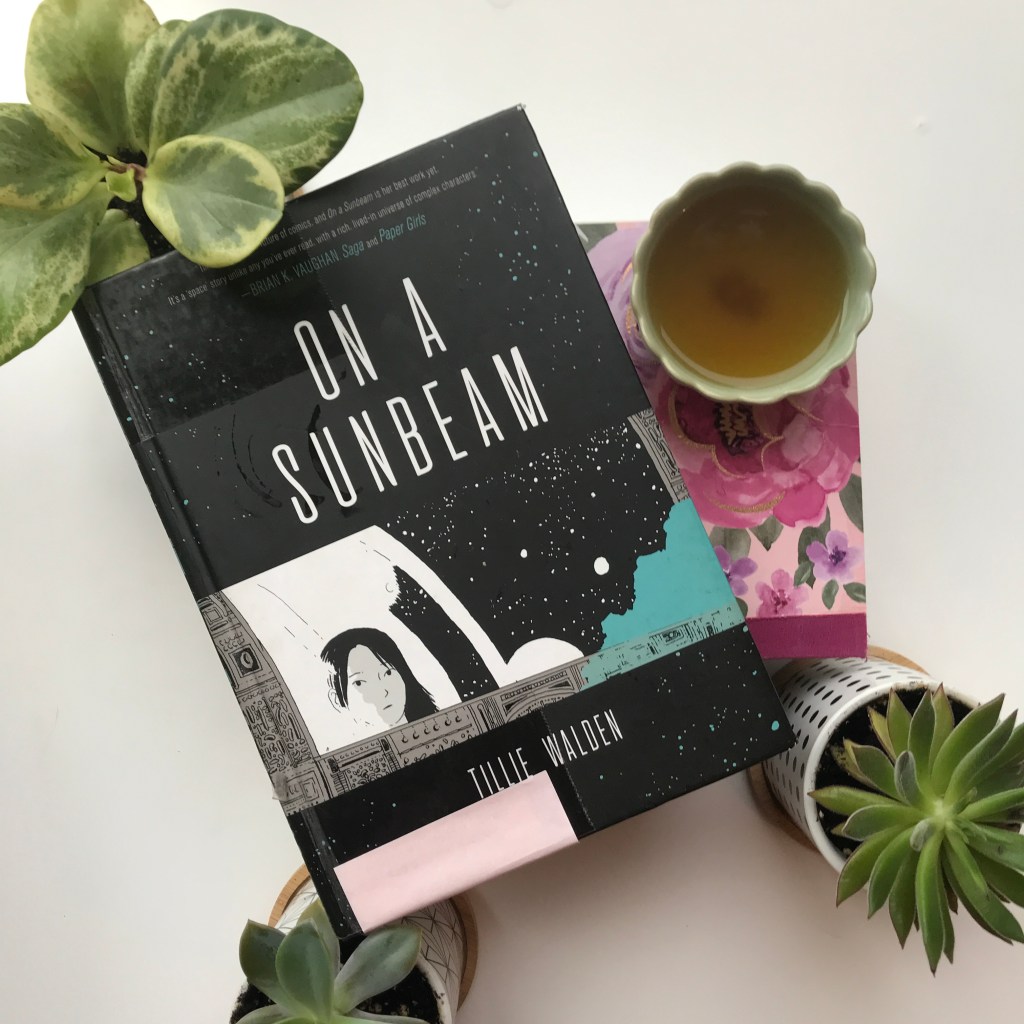
    On A Sunbeam by Tillie Walden

    Throughout the deepest reaches of space, a crew rebuilds broken-down structures to reassemble the past. As the newest crew member, Mia gets to know her team, the story flashes back to her time in boarding school, where she first fell in love. Soon, Mia reveals her purpose for joining the crew was to track down her long-lost love.

    On a Sunbeam is a warm blanket. There is so much love between these pages it soothes my soul. First, it is in the form of Sapphic relationships, especially between Mia and her first love, Grace. When Grace is suddenly ripped from Mia’s life, Mia attempts to defy the vastness of the entire. friggin. universe. just to find her again. Second, it is in the form of a found family– the crew Mia connects with to rebuild abandoned buildings in space.

    Beyond the storytelling, Tillie Walden’s illustrations are stunning, and her artwork is among my favorites. Her artwork in Are You Listening? is pretty incredible too.

    P.S. You can read On a Sunbeam online for free here.

  • In Defense of Dangerous by Shannon Hale

    In Defense of Dangerous by Shannon Hale

    I recently read and enjoyed Dangerous by Shannon Hale, which I later found out received a luke-warm reception upon its release in 2014. I rarely do this, but upon finishing the book, I logged on to Goodreads to see what other readers thought of the novel. Huge. Mistake. While I thought this novel was a rip-roaring, sci-fi adventure that… sure, had some kinks to work out, others were reluctant to rate it one or two stars (if they were even able to make it to the end of the novel). I was left wondering if we read the same book.

    (more…)

  • This graphic novel failed a saving throw | Welcome to Gotham Academy by Becky Cloonan, Brenden Fletcher, and Karl Kerschl

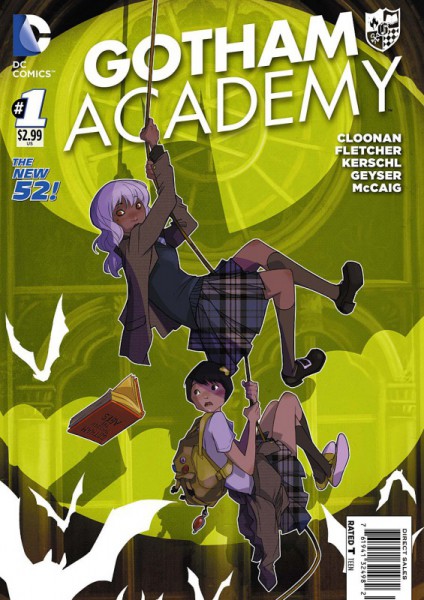
    This graphic novel failed a saving throw | Welcome to Gotham Academy by Becky Cloonan, Brenden Fletcher, and Karl Kerschl

    I’m wouldn’t call myself a passionate fan of Batman, but ever since Jon introduced me to some of his favorite graphic novels of the Caped Crusader, I’ve been hooked. I’ve only read five Batman graphic novels so far, but that number is ever-growing, so when, I discovered my library had the first volume of Gotham Academy by Becky Cloonan, Brenden Fletcher, and Karl Kerschl, I couldn’t resist it.

    There were two really great things about Gotham Academy:

    1. The artwork. Yet again I’ve discovered a graphic novel with beautiful art, scenery rich with detail, and characters that were incredibly stylish.
    2. Maps Mizoguchi. She’s the Dungeons and Dragons-loving, kid sister of Olive’s (our main character) ex-boyfriend. She’s chipper and vibrant and she has all the best nerdy lines referencing her favorite table top game.

    (more…)

  • Earl Grey Lavender Tea is a Fickle Fellow

    Earl Grey Lavender Tea is a Fickle Fellow

    During college, I had a waxing interest in the Steampunk subculture– not to the point where I wore Steampunk-inspired garb– but I did have a handful of Steampunk bands loaded onto my iPod. Abney Park was my favorite. I also frequented Steampunk blogs, and it was through them that I discovered a webcomic called Wondermark by David Malki !. The comic wasn’t really Steampunk, although it did make the occasional reference:

    (more…)

  • This is Another Five Star Review: Ms Marvel, Vol 1: No Normal by G. Willow Wilson & Adrian Alphona

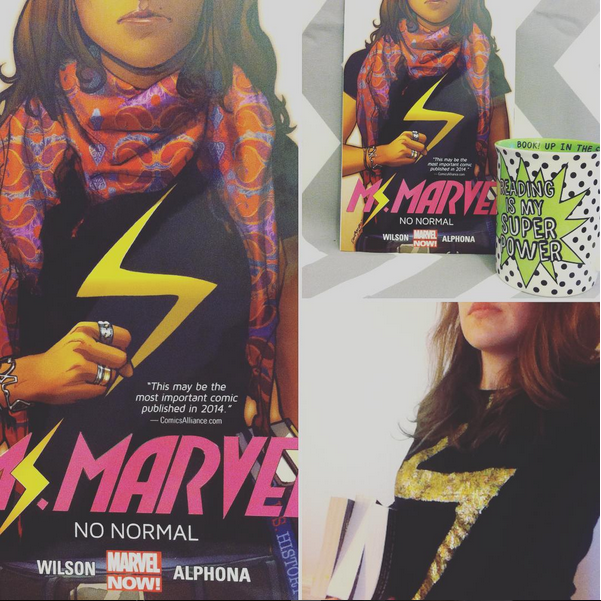
    This is Another Five Star Review: Ms Marvel, Vol 1: No Normal by G. Willow Wilson & Adrian Alphona

    Ms Marvel, Vol 1: No Normal by G. Willow Wilson & Adrian Alphona

    Released: October 2014
    Publisher: Marvel
    Age Group: Young Adult
    Add to Goodreads
    ★★★★★
    Synopsis: Kamala Khan is an ordinary girl from Jersey City — until she’s suddenly empowered with extraordinary gifts. But who truly is the new Ms. Marvel? Teenager? Muslim? Inhuman? Find out as she takes the Marvel Universe by storm! When Kamala discovers the dangers of her newfound powers, she unlocks a secret behind them, as well. Is Kamala ready to wield these immense new gifts? Or will the weight of the legacy before her be too much to bear? Kamala has no idea, either. But she’s comin’ for you, Jersey!

     My Thoughts

    Ms Marvel is the first graphic novel I’ve ever purchased, and the reason I pulled it from the shelf is entirely superficial– the cover. I mean, look at it! It’s intense and powerful. If that was any indication of the story inside, how could I resist? And I definitely wasn’t disappointed. First, the artwork was stunning and the colors were bold;  I’ve only read a handful of graphic novels, but the artwork of Adrian Alphona is my favorite yet. Second, Kamala Khan is a powerhouse. I mean, obviously– she is Ms Marvel. But even when she’s not a super hero, she’s still strong. She’s insistent on experiencing teenage-hood despite over-protective parents and the fact that teenage-hood is an absolutely terrifying time. Also, while she seems shy and awkward, she is also unapologetically her own person (and unapologetically geeky!) even though sometimes she’s still trying figure out who that is. Finally, Ms Marvel: No Normal is a thought-provoking story because it challenges a lot of our social norms– what is considered beautiful, who can be considered a hero, what it means to be American. Kamala Khan may start out transforming into a Carol Danvers look-a-like, but soon she realizes Ms Marvel doesn’t have to be a blonde-haired, white woman as she becomes more confident in herself and her identity.

    If you pick up one graphic novel to read this year, it definitely needs to be this one. I’m still trying to get my hands on Vol 2: Generation Why but my local bookstores never seem to have it in stock!

    Have you read any of the Ms Marvel comics featuring Kamala Khan? What did you think of them?

  • These Broken Stars is Outta This World!

    these broken starsThese Broken Stars by Amie Kaufman & Meagan Spooner
    Released:
    December 2013
    Publisher: Disney Hyperion
    Add to Goodreads
    ★★★★☆
    Synopsis: Luxury spaceliner Icarus suddenly plummets from hyperspace into the nearest planet. Lilac LaRoux and Tarver Merendsen survive — alone. Lilac is the daughter of the richest man in the universe. Tarver comes from nothing, a cynical war hero. Both journey across the eerie deserted terrain for help. Everything changes when they uncover the truth.The Starbound Trilogy: Three worlds. Three love stories. One enemy.

    This is what I loved about These Broken Stars:

    1. Lilac LaRoux. So often are female characters written into un-flexible molds. They are princesses and tomboys and bookworms and the girl next door, but rarely do they cross over. That is not the case for Lilac LaRoux, who has an appreciation for jewel-toned dressed and designer shoes, but can also navigate around printed circuit boards and electrical wiring. Heart-throb Tarver Merendsen may be a hero in the headlines, but Lilac LaRoux is the true hero in this story, driven by her brilliance and bravery.

    2. Soft Science Fiction. I love science fiction movies, and I love science fiction video games, but I do not often read science fiction books. It seems silly, but I’m intimidated by science fiction books because I’m afraid that the ideas will fly right over my head. Soft science fiction makes the genre more approachable though. Even though the ideas may be a little more fantasy than fact, the backdrop is fascinating nonetheless.

    3. Of all the beautiful descriptions about stars and space, this line about Lilac LaRoux’s father is my favorite: “But who names a starship the Icarus? What kind of man possesses that much hubris, that he dares it to fall?” It’s brief. It’s simple. It’s powerful.

    4. This book is equal parts science fiction and romance, but there are no traces of insta-love here. Lilac LaRoux and Tarver Merendsen come from two different worlds and both are influenced by their pride. They are forced into showing each other their vulnerabilities after the Icarus has fallen, and they only have each other to rely on for survival. Watching the pair grow up and grow together revealed more about the two characters than any cliché love triangle.

    5. The mysterious visions. Is it trauma? Is it fantasy? Is it an alien life form? I needed to know what caused Lilac and Tarver to hear voices and see impossible visions. The revelation at the end did not leave me feeling disappointed at all.

    This is what I did not like about These Broken Stars:

    1. The pacing was slow during parts of the book. I suspected that might be the case with These Broken Stars since a majority of the story takes place on a deserted planet. With the exception of the elements and one wildcat, there are very few external conflicts in this book. This can be okay, but their fight for survival became mundane after a few chapters. What kept my drive to read to the end alive was my love for the characters, the mystery of the abandoned terraformed planet, and the strange visions.

    2. I was left with so many unanswered questions about humanity’s role in the universe. They’ve colonized a handful of planets, and wars and rebellions were briefly mentioned, but the authors seemed to gloss over the causes. I wanted to know more, especially what was causing the rebellions.

    Overall:

    Despite the pacing and the unanswered questions, I really enjoyed These Broken Stars. Amie Kaufman and Meagan Spooner crafted a beautifully written book with intriguing characters and mystery. The end of These Broken Stars filled me with so much wonder that I cannot wait to get my hands on a copy of This Shattered World. Even more exciting is the next installment follows two new characters and dives into wars and the rebellions that plague humanity. It’s rare that I want to read beyond book one in a series, which is why I have to give These Broken Stars four stars!

    I received These Broken Stars as a gift from the splendid Kate @ Literary Kate

  • Batman: the Dark Knight Returns by Frank Miller

    Batman: the Dark Knight Returns graphic novel coverBatman: the Dark Knight Returns by Frank Miller, Klaus Janson (illustrator), Lynn Varley (illustrator)
    Released:
    November 2002 (first published 1986)
    Publisher:
    DC Comics
    Add to Goodreads
    ★★★☆☆
    Synopsis: Crime runs rampant in the streets, and the man who was Batman is still tortured by the memories of his parents’ murders. As civil society crumbles around him, Bruce Wayne’s long-suppressed vigilante side finally breaks free of its self-imposed shackles.
    The Dark Knight returns in a blaze of fury, taking on a whole new generation of criminals and matching their level of violence. He is soon joined by this generation’s Robin — a girl named Carrie Kelley, who proves to be just as invaluable as her predecessors.
    But can Batman and Robin deal with the threat posed by their deadliest enemies, after years of incarceration have made them into perfect psychopaths? And more important, can anyone survive the coming fallout of an undeclared war between the superpowers – or a clash of what were once the world’s greatest superheroes?

    My Thoughts

    Batman tv series (1966-1968)
    Batman tv series (1966-1968)

    I should preface this by saying, I rarely read graphic novels, and when I do read them, I certainly do not read superhero graphic novels (unless you count Sailor Moon manga). So as I read Batman: the Dark Knight Rises by Frank Miller, I was simultaneously underwhelmed and overwhelmed. This comic is lauded as one of the most (if not the most) influential Batman comic of all time. It was the comic that breathed life into characters that the 1960s nearly killed off with its campy shenanigans.  Once the comics returned to its gritty and pulp-inspired origins, popularity for the Batman series soared. Yet, just as the 1960s seemed cheesy to fans in the 1980s, the 1980s may seem slightly cheesy to fans today. Whenever I read the slang of the gang of Mutants, I couldn’t help but cringe. It would almost seem nit-picky if it didn’t occupy so many speech bubbles. “I’m a slicer-dicer, spud. A real slicer-dicer”. It’s supposed to be edgy and intimidating, but to me it just seemed silly– like, why are they calling people potatoes?

    robin

    I feel conflicted about the artwork. I can get over the obvious 1980’s influenced accessories and hairstyles, but I found myself disappointed by the inking. I was craving bold lines and vibrant colors, but most of the time I found soft and muted watercolors. That’s not to say that I disliked the artwork entirely. No. There are a number of images ingrained in my mind. Batman looming over a pig of a man, who is dangling upside-down off a Gotham City high-rise. The Joker laying limply in the Love Canal at a carnival, battarang lodged in his eye and slack-jawed. Superman’s body wasting away during the nuclear explosion. I stared at the grotesque images with grim fascination. These few images, juxtaposed against the soft water colors on the previous page, captured something far more sinister than I expected.

    Then there was the plot, which was a little hit-and-miss for me as well, but I think this is one of those “it’s not you, it’s me” instances. I know very little about superheroes and the DC Universe, so I spent a lot of time on Wikipedia or asking my boyfriend a bunch of questions, and this sometimes distracted me from enjoying the comic. I was on board for the first half of the graphic novel, where Bruce Wayne becomes Batman again and fights crime. It was fast-paced and filled with villains I’m familiar with. It was simple enough for a Batman-newb like myself. But I found myself getting disoriented during the second half of the graphic novel. Like, why did the Police force dislike the Batman so much? And why is Superman trying to kill Batman– don’t they basically fight for the same team? Any why is Robin a girl? I mean, I loved it, but I thought Robin was a consistent character– I was wrong.

    Batman Graphic Novels

    Overall, I enjoyed Batman: the Dark Knight Returns. It was successful in making me more curious about the Batman series; I suppose it’s become a gateway. I mentioned in a recent Weekend Review that I have a tall stack of Batman comics to read, and I’ve already began working my way through. I recently finished Venom, and I just started Haunted Knight. I’ve even began perusing the graphic novel shelves at the book store, which was a section I generally stayed away from because really, I had no idea what to even pick up.

    Read Batman: the Dark Knight Returns if you’re a fan of Batman comics– it’s a classic after all. If you’re a newcomer, you might want to start somewhere else because this graphic novel does seem dated, and it requires you to already have some knowledge about Batman and the DC Universe.

    If you’ve read Batman: the Dark Knight Returns, what did you think of it? If you’re a fan of Batman comics, are there any titles you think I ought to check out?

  • Book Report: Dark Parties by Sara Grant

    Dark Parties

    Dark Parties by Sara Grant
    Released:
    March 2011
    Publisher: Little, Brown Books
    Add to Goodreads
    ★★☆☆☆
    Synopsis:
    Sixteen-year-old Neva has been trapped since birth. She was born and raised under the Protectosphere, in an isolated nation ruled by fear, lies, and xenophobia. A shield “protects” them from the outside world, but also locks the citizens inside. But there’s nothing left on the outside, ever since the world collapsed from violent warfare. Or so the government says…

    Neva and her best friend Sanna believe the government is lying and stage a “dark party” to recruit members for their underground rebellion. But as Neva begins to uncover the truth, she realizes she must question everything she’s ever known, including the people she loves the most.

    My Thoughts

    Inside the electrified walls of the Protectosphere is a community cut off from the rest of the world. The government says they’re better off because beyond the Protectosphere lies a wasteland. Citizens may notice luxuries like blueberries, chocolate, and new clothes are disappearing, but at least they are alive.

    But, are they really living when the government determines what job an individual holds? Or tries to brainwash the youth into reproducing at a younger age to save a dwindling population? Are they really alive when troublemakers are injected with tracking devices? Or worse, when family members and friends suddenly disappear during the night? Only the government knows where to, but to question them might create for you the same fate.

    The teens hold Dark Parties to start underground rebellions, to join celibacy pacts, to spray paint anti-government propaganda on city walls. But, when their friends start disappearing, their rebellion fizzles out. Of the youth that attended the Dark Parties, three fighters remain– Neva, Sanna (her friend), and Braydon (Sanna’s boyfriend). Without the support of their peers, the three dig into their government to discover the history of the Protectosphere, and they begin to learn the atrocities their government is capable of.

    Dark Parties by Sara Grant could have been a great novel, but like most of the other books I’ve read in 2013, it fell short of amazing. “Decent” and “all right” are more fitting adjectives. Perhaps my opinion would have differed if I hadn’t read two, awesome dystopians prior to Dark Parties. Already, the novel had some pretty big shoes to fill, and I approached reading it with a more critical eye. At first many of the elements of the society in Dark Parties seemed generic, but as I read on, they started to seem similar. Dark Parties by Sara Grant is to Young Adult as The City of Ember by Jeanne DuPrau is to Middle Grade. I’m not implying Dark Parties is a rip off because there are a few elements unique to its storyline. I am saying that because I’ve experienced a similar story already, Dark Parties failed to excite me. Besides, I liked Lina and Doon better than Neva, Sanna, and Braydon.

    Neva, the main character, lacks passion and personality. Her ability to lead a rebellion seems more a result of circumstance than her own drive. Then there is Braydon, the love interest. He’s dating Sanna, Neva’s best friend, but Braydon is trying to become intimate with Neva, too. And Neva falls for it! As I read the story, I kept wondering how Neva could be attracted to a guy, who is two-timing her best friend. Hoes before Bros, amiright? Even worse, Neva is barely remorseful about it. I mean, she keeps saying she feels bad, but she still pursues Braydon. Aside from his teenage infidelity, Braydon lacks a personality, like Neva. (Perhaps they are meant for each other after all.) He’s pseudo-mysterious. He appears to be brooding, but that’s only because he doesn’t have anything valid to offer in a conversation. He does drive a motorcycle though, and everyone knows the ladies find motorcycles sexy or something. Braydon seems to exist merely as a plot device– Neva’s temptation to break her celibacy pact. But, I feel like the author should have given Neva someone more worthwhile and convincing. Sanna is about the only character in the story that is interesting, though at times she seems artificially sweet. Regardless, she has more passion, she has more challenges to overcome, and she has more life-altering decisions to make. Why couldn’t the story have been about Sanna?

    While most of the characters lacked substance, the world didn’t. About 16 chapters in, the reader learns the founding fathers of the Protectosphere were xenophobic. The Protectosphere was developed to keep the effects of globalization out– no sharing religion, no sharing language, no sharing culture, no sharing ideas. I think this is an interesting idea given the shrinking world we live in, but I don’t think the idea was explored as well as it could have been. In fact, it caused a few holes in the world building. Earlier in the story, Neva laments over blueberries, which are no longer available in her world. Except, chances are, if she’s living in America or Europe, blueberries probably grow…naturally. Things like coffee and gas for cars still exist in Neva’s world though, and both of these most definitely would have to have been exported from the outside world. Unfortunately, I didn’t sense any irony or hypocrisy here, which makes this aspect of the world seem underdeveloped.

    Even though I didn’t find the storyline compelling for the most part, I continued to read because I kept hoping the story would improve. And improve it did. Things took a turn for the better when Neva infiltrates the Women’s Empowerment Center. For the first time, the reader and Neva understand the grotesque and horrible things the government does to its people, its women. Finally,  a fire sparks in Neva; she realizes what she’s fighting for and fighting to get away from. Then, Grant leads us through a series of twists and turns and twists that had me at the edge of my seat. And just when I thought things could get any more satisfying, the last few pages happened. The end. OH MY GOD! I mean, I can’t tell you what happens because spoilers, but trust me when I say the ending was perfect. Unexpected. Thought-provoking. Grant doesn’t wrap up Dark Parties neatly with a nice little bow. As many answers are provided as questions are created in those last few pages. I guess you could say the story ends on a cliffhanger, which I understand is an acquired taste. I’m obviously a huge fan of them. I like it when a little is left up to the imagination, and since this book appears to be a stand-alone, all I will have is my imagination. I loved that the ending of Dark Parties filled me with as much wonder as it did Neva.

    Read Dark Parties if you enjoy dystopian novels but haven’t read too many stories that fall into that genre. The character development and world building seemed worn out at times, but Grant’s storytelling shines during the second half of the novel. I’m not even being cheeky when I say the ending of Dark Parties makes it a book worth reading.

    Giveaway hosted by Khy @ Frenetic Reader
  • Book Report: Divergent by Veronica Roth

    Divergent by Veronica Roth

    Divergent by Veronica Roth
    Released:
    May 2011
    Publisher: Katherine Tegen Books
    Add to Goodreads
    ★☆☆☆☆
    Synopsis:
    In Beatrice Prior’s dystopian Chicago world, society is divided into five factions, each dedicated to the cultivation of a particular virtue–Candor (the honest), Abnegation (the selfless), Dauntless (the brave), Amity (the peaceful), and Erudite (the intelligent). On an appointed day of every year, all sixteen-year-olds must select the faction to which they will devote the rest of their lives. For Beatrice, the decision is between staying with her family and being who she really is–she can’t have both. So she makes a choice that surprises everyone, including herself.

    During the highly competitive initiation that follows, Beatrice renames herself Tris and struggles alongside her fellow initiates to live out the choice they have made. Together they must undergo extreme physical tests of endurance and intense psychological simulations, some with devastating consequences. As initiation transforms them all, Tris must determine who her friends really are–and where, exactly, a romance with a sometimes fascinating, sometimes exasperating boy fits into the life she’s chosen. But Tris also has a secret, one she’s kept hidden from everyone because she’s been warned it can mean death. And as she discovers unrest and growing conflict that threaten to unravel her seemingly perfect society, she also learns that her secret might help her save those she loves . . . or it might destroy her.

    My Thoughts

    For the most part, there are more important things to me than world building. I’d rather get trapped in a character’s mind or a character’s conflict than in their world. I think this is why I struggled with the Lord of the Rings trilogy. Sometimes there is a perfect balance of world building, adventure, and character development like in J.K. Rowling’s Harry Potter series.

    And then there is Divergent by Veronica Roth, a reading experience for which I struggle to find adequate words to describe it. The world in Divergent is so full of holes and contradictions that it was distracting.

    Divergent takes place in Chicago in the future. Readers know this because famous landmarks are name dropped on occasion—the Navy Pier, Lake Michigan, the Hancock Building. If you’re not familiar with Chicago, you’re screwed. Roth doesn’t make it a point to paint you a cityscape. Nothing about the scents and sounds and hustle n’ bustle is mentioned. Even the lack of the aforementioned is not described. I had no concept of how Chicago may have changed due to the dystopian society, and I had no idea how the people actually interacted with the city. It became like a backdrop in a middle school play—poorly painted and only there so the characters can walk in and out of door frames. Chicago was so vague that I didn’t even realize that the train the Dauntless were jumping from was the famed L-Train; I thought they were just your run-of-the-mill freighters that roar through the rest of the Midwest. (This explains why I kept wonder what the big deal was because gunslingers and hobos have been jumping in and out of freight cars since they first invented the dang steam engine).

    Then there is the matter of the society that induced MASSIVE amounts of eye rolling.

    It’s mentioned in passing that the people grew dissatisfied with war and greed, so they decided to do something about it. This is hardly the cataclysmic event that leads to dystopian societies, but whatever. Chicago in the future is divided into factions based on personality traits: Abnegation (selflessness), Amity (…niceness?), Candor (honesty), Erudite (intelligence), and Dauntless (daring). It’s believed that nurturing one of these traits can eliminate all of the injustices in the world. For example, the Abnegation raised their children to be selfless because they thought greed was the downfall of the world. Uh, what? Further, there is this type of person considered Divergent, which means they embody multiple personality traits; it’s dangerous to be Divergent. But…human nature will inevitably kick in, and so most of the people will at some point value multiple and perhaps contradicting traits. It’s evident when the kids choose their factions when they’re 16. One may have been nurtured to be selfless, but desire for knowledge may truly be in their heart, so they abandon their old faction for a new one. Based on this pretty much everyone would be in some sense Divergent.

    Also, I should mention that this is all disregarding the Factionless who are such because they chose to or they failed their initiation. Everyone pretty much views them as the scum of the earth. I don’t know why they haven’t started a rebellion yet. Those factions are so bourgeois!

    I read somewhere that if you can get past the poor world building, Divergent is a really fun novel. I’m not so sure I agree with that statement. Most of Divergent takes place during the Dauntless initiation. It was like…oh God, 400 pages of boot camp and daredevil stunts. During initiation, potential Dauntless candidates learn how to shoot guns, throw knives, and beat the ever-living stuffing out of each other. Because that’s what real daring people do. Every day is Fight Club when you’re brave. I felt like there was an extreme lack of story line during initiation.

    The violence in this book made me uncomfortable. Bloody noses and broken bodies don’t make me squeamish, but lack of remorse surrounding those things does. The Dauntless candidates are cold. The main character, Tris, is cold. And they weren’t even raised or brainwashed to think this way. Tris’s passive past and aggressive present is alarming, and it’s not even because she’s a Divergent. The rest of the other candidates from Candor and Erudite are equally, if not more aggressive. Drawing blood is bravery. Almost killing your friends is bravery. Being able to stand in front of a target while someone throws knives at you is bravery. Really? It’s not like they’re even training to butt-kick enemies; they’re just beating the crap out of each other. Why? What’s the point?

    The other half of the story revolved around the “shocking” appearance of the Dauntless. They had tattoos and facial piercings and wore leather jackets. I think the last time this kind of attire was considered shocking was…when? The 1980s? Roth successfully described half of my friends.

    More annoying than the world were the characters because they’re all flat and symbolic of their initial faction. You know what they say—once a Candor, always a Candor. (They don’t really say that, I just made it up).  Oh, but really they’re Dauntless. You can tell from their left hooks.

    And then there is Tris, who is a walking contradiction—and not because she’s Divergent. One minute she’s all gung-ho about beating someone to near death and ziplining off the Hancock Building because that’s what daring people do. The next, she thinks her bravery actually lies in her Abnegation values, which I think is a valid conclusion.  Then she back tracks during the next chapter when she’s channeling Chuck Norris and repeating her mantra—I am brave. I am Dauntless. My biggest pet peeve is a nitpicky one that revolves around her motives. During the last 40 pages, something interesting actually happens. And during these 40 pages, Tris comes face-to-face with several enemies. Her new-found Dauntless-ness means she should be able to kill them on the spot, but her Abnegation side keeps surfacing. Instead she decides to disable them by shooting out their knee caps. But then, when she’s face-to-face with a friend, she lodges a bullet between his eyes and doesn’t think twice about it. That’s what being Dauntless is all about afterall. But, wait…why couldn’t she just disable this person like she did to all of her enemies? But, it’s okay! Because this will provide conflict for future novels, I’m sure. Tris will have to deal with the regret of taking her friend’s life over her enemies’. LOL Tris, you don’t make any sense.

    Oh, and don’t even get me started on Four, Tris’s love interest. He has about as much personality as Molly Ringwald’s character’s love interesting in Pretty in Pink. He treats Tris like garbage in front of the faction because the two have to keep up their appearances. That’s supposed to justify things? How is this not the same, problematic relationship we see time and time again in young adult novels these days?

    Overall,
    I didn’t like this novel, and I do not understand the hype surrounding it. Goodread choice of the year…really? I won’t be continuing this series. I don’t even want to hit of wikipedia to find out what happens next. Read at your own risk. If you like your action with a side of action, have at it. But, I don’t really feel like I can recommend this book because I didn’t find anything redeeming about it. But, there are loooooads of people who LOVE Divergent. Here is a raving, five-star review. Heck, here is a well-balanced 3-star review.

  • Book Report: Matched by Ally Condie

    Matched

    Matched by Ally Condie
    Released:
    November 2010
    Publisher: Dutton Juvenile
    Add to Goodreads
    ★★★☆☆
    Synopsis:
    Cassia has always trusted the Society to make the right choices for her: what to read, what to watch, what to believe. So when Xander’s face appears on-screen at her Matching ceremony, Cassia knows with complete certainty that he is her ideal mate… until she sees Ky Markham’s face flash for an instant before the screen fades to black.

    The Society tells her it’s a glitch, a rare malfunction, and that she should focus on the happy life she’s destined to lead with Xander. But Cassia can’t stop thinking about Ky, and as they slowly fall in love, Cassia begins to doubt the Society’s infallibility and is faced with an impossible choice: between Xander and Ky, between the only life she’s known and a path that no one else has dared to follow.

    My Thoughts

    I was weary about reading Matched by Ally Condie (how many times have I started out my reviews like this?). For starters, I was very much aware of the hype surrounding the book– something that probably would have eluded me if it weren’t for fellow book bloggers. Don’t get me wrong, hype isn’t inherently bad, but it’s often hit and miss. I was also weary because based on the summary and other bloggers’ reviews, Matched revolved around a romance, and I’m always skeptical of romance in young adult books. (Then again, I’ve said that here, here, and here, and I’ve been pleasantly surprised each time. Maybe my tastes have evolved, and I shouldn’t be so quick to put my nose up.)

    Matched by Ally Condie paints a bleak portrait of a Western society that a government has, at one point, deemed to be over saturated with culture. Now, the world Cassia knows has been reduced to just 100 paintings, 100 poems, 100 songs, etc. Also, there is little choice in Cassia’s world. Decisions are left to statistics and the Sorters who analyze them. An individual’s vocation, the type and amount of food they eat, the types of activities in which they can participate, where they live, and who they marry is predetermined by Officials. And yet, this society, built and maintained by officials and statistics is about to crumble. By doing the things we take for granted, like learning to write cursive, reciting [forbidden] poetry, and falling in love with someone [she wasn’t matched with], Cassia is challenging the very foundations on which her society is built.

    I really appreciated the way Ally Condie incorporate poetry into Matched. For example, “Do not go gentle into that good night” by Dylan Thomas had a functional purpose in the prose. By just knowing the poem, Cassia risks her family’s well-being. The poem also has value among a cultural black market too. Then the poem is also symbolic of Cassia’s character, yet it doesn’t seem trite.

    What I loved most about this book? Dare I say it? The love triangle. I never thought I’d see the day where those words were ever typed by my own fingers. The love triangle seemed natural; it did not seem forced– not like, there is a love triangle in this story for the sake of having a love triangle (see also: for the sake of all things trendy or for the sake of the ever lusty reader). The relationships made sense! Cassia loves Xander, her most handsome BFF4E. And, according to the statistics, they are each other’s perfect match; there should be no second guessing, right? Yet, when a glitch in the matching (or better yet a mistake) makes the ever mysterious Ky the apple of Cassia’s eye, things start to tumble out of control. He’s handsome and familiar like Xander, but he is also an anomaly. An anomaly– that’s not a good thing, by the way.

    Perhaps my only complaint about the story is the vagueness of the geography and current events. I wish there was an illustrated map on the inside cover or something! What I wanted to know was where Cassia lived in reference to the war-torn Outer Provinces. Where is Cassia’s world in reference to our world? I’m also kind of confused about the war that’s going on. I have to assume that Ally Condie is only letting on as much information that Cassia’ would be aware of, but it’s frustrating because so little information was given that I kept forgetting about the war. That being said, I’m really interested to know why a perfect society would be at war.

    Overall,
    I loved this book, and I devoured it in three sittings. I thought the characters and the world were rich with development, and I though Cassia’s relationship with Xander and Ky was lovely and genuine.

    Won from Ren @ Ren’s Rambles