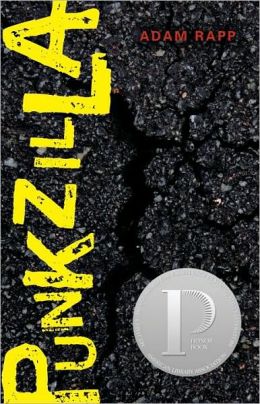
• Book Report: Punkzilla by Adam Rapp

    Punkzilla by Adam Rapp

    Punkzilla by Adam Rapp
    Released:
    May 2009
    Publisher: Candlewick Press
    Add to Goodreads
    ★★★★☆
    Synopsis:
    For a runaway boy who goes by the name “Punkzilla,” kicking a meth habit and a life of petty crime in Portland, Oregon, is a prelude to a mission: reconnecting with his older brother, a gay man dying of cancer in Memphis. Against a backdrop of seedy motels, dicey bus stations, and hitched rides, the desperate fourteen-year-old meets a colorful, sometimes dangerous cast of characters. And in letters to his sibling, he catalogs them all — from an abusive stranger and a ghostly girl to a kind transsexual and an old woman with an oozing eye. The language is raw and revealing, crackling with visceral details and dark humor, yet with each interstate exit Punkzilla’s journey grows more urgent: will he make it to Tennessee in time? This daring novel offers a narrative worthy of Kerouac and a keen insight into the power of chance encounters.

    My Thoughts

    I’ve put off writing a review for Punkzilla by Adam Rapp because I’m a little intimidated. Punkzilla was given a Printz Honor medal, which means this book is legit. That shouldn’t matter but it does because people who actually know what they’re talking about hold this book high in esteem. What more can I say about it?

    Books like Punkzilla send conservative parents in a book-banning tizzy. It touches on drug use, homosexuality, pedophilia, the struggles of transgendered individuals, sex, mental abuse, and death. It’s hard to believe that all of that exists within 200 pages of a young adult novel. None of it is gratuitous, but I’d be lying if I said parts of this book didn’t make me uncomfortable. Sometimes that’s the point though.

    The story of Punkzilla is told through a collection of letters. Most of the time, Punkzilla is writing to his dying brother, but letters from Punkzilla’s family are sprinkled throughout. These letters from Punkzilla’s family present a different side to the story or at least provide a richer reading experience. Throughout his letters, Punkzilla’s voice seems genuine. I mean, if you can get over the fact that few thirteen year olds could write that way stylistically, then it seems genuine. He writes like his mind if going a mile a minute from the meth he did the night before. He’s so honest in his letters about all the horrible things he’s done. But what’s even more interesting is, despite his hooligan tendencies, his innocence shines through when he meets various people on his travels. It’s in these instances the reader catches a glimpse at how vulnerable Punkzilla is, and really it’s kind of heartbreaking.

    The only letdown in Adam Rapp’s Punkzilla was the ending. Don’t get me wrong, I liked the ending. Punkzilla’s decisions left me satisfied. But, I thought it ended rather abruptly, like Rapp ran out of steam.

    Overall,
    I really enjoyed this book, but it left me feeling pretty heavy at the end. I guess that’s a sign of a job well done.


  • Book Report: The Clockwork Angel by Cassandra Clare

    The Clockwork Angel by Cassandra Clare

    The Clockwork Angel by Cassandra Clare (Infernal Devices #1)
    Released:
    August 2010
    Publisher: Margaret K. McElderry Books
    Add to Goodreads
    ★☆☆☆☆
    Synopsis:
    When sixteen-year-old Tessa Gray crosses the ocean to find her brother, her destination is England, the time is the reign of Queen Victoria, and something terrifying is waiting for her in London’s Downworld, where vampires, warlocks and other supernatural folk stalk the gaslit streets. Only the Shadowhunters, warriors dedicated to ridding the world of demons, keep order amidst the chaos.

    Kidnapped by the mysterious Dark Sisters, members of a secret organization called The Pandemonium Club, Tessa soon learns that she herself is a Downworlder with a rare ability: the power to transform, at will, into another person. What’s more, the Magister, the shadowy figure who runs the Club, will stop at nothing to claim Tessa’s power for his own.

    Friendless and hunted, Tessa takes refuge with the Shadowhunters of the London Institute, who swear to find her brother if she will use her power to help them. She soon finds herself fascinated by—and torn between—two best friends: James, whose fragile beauty hides a deadly secret, and blue-eyed Will, whose caustic wit and volatile moods keep everyone in his life at arm’s length . . . everyone, that is, but Tessa. As their search draws them deep into the heart of an arcane plot that threatens to destroy the Shadowhunters, Tessa realizes that she may need to choose between saving her brother and helping her new friends save the world. . . . and that love may be the most dangerous magic of all.

    My Thoughts

    There were two things I liked about The Clockwork Angel by Cassandra Clare– Church, a cat adopted by the Shadowhunters at the end of the book, and Jem (James), one of Tessa’s love interests (supposedly, but more on that later). The rest was mediocre at best if not just downright boring. 479 pages isn’t that long, but 479 pages of The Clockwork Angel took me five months to plow through.

    The beginning was interesting enough. I was mildly intrigued by Tessa’s supernatural ability. And I was even more intrigued by the Dark Sisters, their icky lifestyle, and their desire to please this Magister fellow. Who is he? I wanted to know! (I’ll admit, when his identity was revealed, I was pleasantly surprised).  But then, chapters 3 through 20 happened. As much as I wanted to throw the book down like I did with Heart of Darkness, I couldn’t because I spent my hard-earned money on a hardback copy of the book. I kept hoping that there would be some redeeming quality by the end of the book (besides Church, the cat) that would have made it all worthwhile. But, at the end of my reading experience, I was left wishing I could have had my lunch breaks back to spend doing something more interesting…like taking a working lunch to organize my filing cabinets.

    First, the pacing is all off in this book. There are maybe one or two interesting and action packed scenes in The Clockwork Angel (ie. where vampires died and stuff), but everything else seemed to drag on for chapters. Anything interesting was but a blip amongst 479 pages of boring and stuffy writing. Just, not a whole lot happened. Really.

    I also found it difficult to immerse myself in the world that Clare created. It’s Victorian England with a vaguely steampunk aesthetic, but the title and the cover might suggest otherwise. Don’t be mislead like I was. There were only two things I found remotely steampunk.

    1. The clockwork angel necklace Tessa wears. In all honesty though, you’ll probably forget all about this trinket until the very last chapter of the book. Nevermind that it’s the title of the book.
    2. The automatons. These automatons are jokes though because MAGIC and the full moon bring them to life, not…well, anything remotely mechanical or scientific.

    It’s like Clare discovered Steampunk was popular and thus a viable money source, so she adhered some cogs and brass to the pages of her book and called it good. If you have the audacity to try to pass this off as steampunk, at least give us something more. Like zeppelins or something.

    Zeppelin LZ 4 or Led Zeppelin. You pick, either will suffice.
    Zeppelin LZ 4 or Led Zeppelin. You pick, either will suffice.

    I found the characters to be annoying as well (sans Jem and Church, mind you). Tessa was annoyingly prudent and proper, and all she seemed to do was slander England. Will was an asshole, so naturally the female main character pines for him. Jessamine could have been interesting because she seemed like the only character who had a valid internal struggle. Unfortunately, she acted like a spoiled and superficial brat. As for the rest of the characters? I can’t even remember their names. Or their personalities. Or their involvement with the story line! I think the characters in this book were one-dimensional caricatures rather than a character with any sort of depth. I’m pretty sure there was a tinkerer whose experiments always went awry [EDIT: Yes there was. His name was Henry Branwell].

    Finally the romance. The Goodreads summary suggests there is some quality, love triangle action going on in The Clockwork Angel. And maybe this is expanded upon in later books. But, I’m not even spoiling the story for you by saying there isn’t one iota of a love triangle going on in this book. That should be a good thing, right? Instead, Tessa pines for Will Herondale, the book’s biggest jerk, and she immediately friendzones Jem. For shame, Tessa! Will has a shady past that he uses as an excuse to put up his guard. He’s just mean to the other characters in the book, especially Tessa. Jem has a shady past to, but he’s open and honest about it with Tessa. And he’s a really kind, caring, and genuine individual. I wonder why the female main characters never fawn over the guy I would. It leads me to believe that some authors have really poor taste in men. Someone, please explain to me what’s so romantic about a jerk who makes you question your worth. Why is this even trendy?

    Overall,
    I didn’t like the book. And that really sucks because I’m genuinely interested to learn why Will is such a shifty character and what kind of supernatural being is Tessa. Do they have Cliffsnotes for this? Read…at your own risk. I didn’t like this book, but other people do. Take this book review from Truly Bookish– she says the exact opposite of what I do! But, if you’re a fan of the Mortal Instruments series, approach The Infernal Devices with caution. From what I’ve read on Goodreads, there are many people who loved the Mortal Instruments series but hated the Infernal Devices because it was too similar to the series they adored first.

    I’m sad that this is my introduction to Cassandra Clare. So many book bloggers, nay readers, out there seem to adore her characters and the world she created. Maybe I just started with the wrong book. Tell me, should I take a chance and give Clare’s Mortal Instrument series a try?


  • Book Report: Timeless by Alexandra Monir

    Timeless

    Timeless by Alexandra Monir
    Released:
    January 2011
    Publisher: Random House Children’s Books
    Add to Goodreads
    ★★★☆☆
    Synopsis:
    When tragedy strikes Michele Windsor’s world, she is forced to uproot her life and move across the country to New York City, to live with the wealthy, aristocratic grandparents she’s never met. In their old Fifth Avenue mansion filled with a century’s worth of family secrets, Michele discovers a diary that hurtles her back in time to the year 1910. There, in the midst of the glamorous Gilded Age, Michele meets the young man with striking blue eyes who has haunted her dreams all her life – a man she always wished was real, but never imagined could actually exist. And she finds herself falling for him, into an otherworldly, time-crossed romance.

    Michele is soon leading a double life, struggling to balance her contemporary high school world with her escapes into the past. But when she stumbles upon a terrible discovery, she is propelled on a race through history to save the boy she loves – a quest that will determine the fate of both of their lives.

    My Thoughts

    Book hype can be a double-edged sword. On one hand, it certainly draws attention to a book, and it can help drive sales. On the other hand, the more the book is built up, the farther it has to fall. Such was the case with Timeless by Alexandra Monir. I had high hopes for Timeless. Every review I read about the book seemed to rave about it. But, after I finished the book I was left scratching my head and wondering why. Now wait just a tick! This is already starting to sound like a negative review. I promise you, it’s not really. It’s just one of those books that made me wonder why there was all the hype.

    As an individual who loves character development and character driven plot, Timeless left me feeling disappointed. All of the characters in this book read a little generic to me. Michele was alright as a protagonist because she wasn’t annoying, whiny, weak, or any other negative personality trait that really grates my nerves. But, she didn’t really stand out to me either. She wasn’t the kind of character I could relate to or empathize with. Unfortunately, I felt that way about most of the other characters in this book except for Lily, one of the Windsor ancestors Michele meets during a time travel episode. Even though Lily is essentially a caricature of a 1920s flapper girl, I couldn’t help fall in love with her boldness and her sass.

    Then there is the issue of the romance. Michele has been having dreams of a handsome boy with astonishing blue eyes all her life. During one of her time travel episodes, she comes across him. This boy! He’s real! His name is Phillip Warren! And then they start a cross-time love affair. I mean that kind of literally since Michele’s presence causes Phillip to break off his engagement with another one of Michele’s ancestors. And then ever since, the Windsors have hated the Warrens. Way to go Michele. You’ve started at century long family feud. Anyway, I digress. I get the feeling that Michele falls in love with the idea of Phillip and not Phillip himself. I understand she’s been having dreams of him forever, but that’s all they really are– dreams. Throughout Michele’s time travel episodes, she probably has only spent literally 2 or 3 days total with Phillip. And yet, she professes her love to him! And he breaks off an engagement! I mean, if ever there were a case of insta-love, it’s present in Timeless. And, the whole time I’m wondering, if 100-year-old Phillip Warren were still alive in Michele’s time, with his wrinkles, grey hair, and liver spots, would she still love him? I mean, that’s the kind of thing you have to take in consideration when time travel is involved!

    When Phillip and Michele weren’t professing their love to each other, they were writing and composing songs together. As a music lover, I should have appreciated this, but it just came across as really cheesy. Especially when the song lyrics were included in the book. Song lyrics out of context make me cringe. On the plus side, Alexandra Monir actually had these songs produced, and you can listen to them on her website. In this context, the songs are wonderful! Especially Bring the Colors Back. Monir’s vocals and the jazz band sound really capture the 1920s atmosphere. Unfortunately, this isn’t a review on Monir’s singing abilities.

    The final aspect of the book that struck me as problematic was the time travel. Time travel is pretty neat, but I imagine it’s difficult to write about. There seemed to be a lot of inconsistencies in the time travel in Timeless. Michele has no control over her time travel episodes. All we know is that it involves a special key necklace and maybe an old Windsor relic (most of the time). Except for that one time when Michele suddenly hopped back in time when she was watching a Broadway show. Uh wut? But, then Monir tries to go scientific on her readers. One of Michele’s new, smart friends brings up Einstein’s theories of time travel as a way to justify her belief that Michele is actually traveling through time. But, it just doesn’t work for me as a reader. Because there is no scientific basis for Michele’s experience. A key necklace does not even have the physical properties to bend space-time, so don’t try to convince me that it does. Also, there are inconsistencies in the way Michele meddles with the past. At first, she has no problem stealing the heart of her great-great-great aunt’s fiance. But, she’s too afraid to tell her aunt from the 1940s that America wins WWII. She thinks if she spills the beans America will lose the war. Really? Telling one insignificant person that there is hope will ruin the world? But, boyfriend fiance-stealing is okay.

    I’m sure by now you’re wondering why I stuck around for 304 pages. I thought the characters were alright, I hated the romance, and I pointed out all the inconsistencies in Monir’s time travel. But honestly, at the end of it all, I simply loved Monir’s writing. The descriptions were beautiful, and I could see the events unfold in my head. Even more, Monir’s accounts of America in the past were stunning. The atmosphere she created and the descriptions of new Ford Model Ts along side horse and carriages just struck a chord in me. It’s so evident that Monir put a lot of time and research into the eras she wrote about, and I whole-heartedly appreciate that as a reader. Also, Monir wrote about the Gilded Age. The only time I’ve read about the Gilded Age was in 10th grade, and I read about it in a school textbook. I found Monir’s inclusion of this time period to be absolutely fascinating!

     Overall,
    Due to all of the inconsistencies, this book was mostly a miss for me. But, because of Monir’s beautiful writing and in-depth research I stuck around for the entire book. There were aspects of this book that were lackluster, but then there were aspects of this book that made the book hard to put down. I’m truly conflicted!

    Won from Kathy @ I Am a Reader Not a Writer

  • Book Report: The Demon King by Cinda Williams Chima

    The Demon King

    The Demon King by Cinda Williams Chima (Seven Realms #1)
    Released:
    November 2009
    Publisher: Hyperion Books
    Add to Goodreads
    ★★★★☆
    Synopsis:
    When 16-year-old Han Alister and his Clan friend Dancer encounter three underage wizards setting fire to the sacred mountain of Hanalea, he has no idea that this event will precipitate a cascade of disasters that will threaten everything he cares about. Han’s life is complicated enough. He’s the former streetlord of the Raggers—a street gang in the city of Fellsmarch. His street name, Cuffs, comes from the mysterious silver bracelets he’s worn all his life—cuffs that are impossible to take off. Now Han’s working odd jobs, helping to support his family, and doing his best to leave his old life behind. Events conspire against him, however. When members of a rival gang start dying, Han naturally gets the blame.

    Meanwhile, Princess Raisa ana’Marianna has her own battles to fight. As heir to the Gray Wolf throne of the Fells, she’s just spent three years of relative freedom with her father’s family at Demonai Camp—riding, hunting, and working the famous Clan markets. Now court life in Fellsmarch pinches like a pair of too-small shoes.

    Wars are raging to the south, and threaten to spread into the high country. After a long period of quiet, the power of the Wizard Council is once again growing. The people of the Fells are starving and close to rebellion. Now more than ever, there’s a need for a strong queen. But Raisa’s mother Queen Marianna is weak and distracted by the handsome Gavan Bayar, High Wizard of the Fells. Raisa feels like a cage is closing around her—and an arranged marriage and eroded inheritance is the least of it.


     My Thoughts

    I love fantasy movies, but fantasy novels? Not so much. I like books that are character-driven, and it would seem that the majority of fantasy novels I’ve read are the antithesis of that. I can appreciate exquisite world building just as much as the next person, but that won’t keep my attention for long unless I fall in love with the characters. But, I’m happy to say The Demon King by Cinda Williams Chima kept me enthralled from start to finish.

    I loved the characters in this book. Even though they were a tad archetypal, their attitudes, their motives, their personalities were refreshing. First there is Han “Cuffs” Allister. If ever there was a male protagonist to make me swoon, Han is that character. And apparently he makes several of the ladies in the Seven Realms swoon too. He’s handsome. He’s cunning. He’s mysterious (just what are those cuffs he’s worn since he was a babe, and why won’t anyone let him take them off?). He’s also reformed! He used to spend his days as one of the most feared street lords (see: thief). But, it caused his mother and sister too much grief, so he put his life of crime behind him (d’awww). But, just try convincing rival street gangs and local law enforcement. Even though he’s been “clean”, he’s always finding himself in trouble. Or is trouble always finding him?

    Then there is Princess Raisa. I thought she was going to be another stuck up princess in a poofy gown, but this girl has an admirable strength within her that we only begin to see in book one. She’s the kind of female protagonist who gets to get her hands dirty AND she gets to wear the most luxurious gowns. She doesn’t have so sacrifice femininity for strength, and I love that about Raisa. Her mind is more preoccupied about living life among her kin in Marisa Pines (a place of common folk, naturalists, and Demonai warriors) than living in her royal court. She’s more interested in military affairs than debutante balls. And she’s more interested in playing the field than settling down with one suitor (because, you know, she just turned 16, which is the age that most ladies get married off); this especially is refreshing.

    Chima also creates some deliciously evil characters. They’re the types of people who use their status and power to strike fear into the hearts of others. They also harbor a mysterious, magical power that was thought to have been banned centuries ago, and they’re now using it to their advantage. But, their true motive has yet to be revealed, and I’m dying to know. And on top of that, Chima kind of blurs the lines between evil and misguided. One moment you’re thinking “burn him at the stake!”, and the next minute you’re thinking, “Awww, now my heart is crying for him”. You’re toying with my emotions Cinda Williams Chima! And it feels so right.

    I could prattle on about how great Chima’s world building skills are, but that would take forever. So, I’m thinking you’re going to have to take my word on it. The world building in The Demon King was exquisite. From the vivid descriptions of the locations in the Seven Realms to the hierarchies and the every-day-life of the societies in the Seven Realms, Chima wins at world building. Oh, that’s not to forget the conflicts between the realms or the conflicts between the different social groups. Or the religion or the way magic works. With any book that includes world building, some slow spots in pacing can be expected, but I wasn’t as bothered by it as I thought I would. I love the characters and the action that are in the book, but I also loved reading about the different realms and the folktale that lends its name to the title of the book. Chima’s work was truly wonderful.

    Overall,
    I loved this book. I loved this book! And, I am very lucky that I have the next few books in the series, so I can dive right into them whenever I want. After the ending (with all it’s plot twists and drama), I’m dying to know what happens next! Read this book if you’ve ever picked up the Lord of the Rings and then put it down and walked away from it half way through the series because you couldn’t take it anymore. The Demon King is written in a way that’s easier to digest for those who are not normally nuts about high fantasy. Chima figured out the perfect balance between character development, plot, and world building, and it opened me up to try out other books in the (high) fantasy genre. Additionally, read if you’re nuts about Bethesda’s Elder Scroll series. (I’m actually mostly kidding about that last one, but I really couldn’t help but notice some similarities between the book and the Elder Scroll games.)

    Won from Heather @ Proud Book Nerd

  • Teaview:  What do you mean you’re not black tea?

    Teaview: What do you mean you’re not black tea?

    Every so often I’ll dive into a cuppa tea without reading into what I’m drinking, and I’ll make some pretty rash assumptions. This happened recently when I was brewing myself a cup of Adagio’s Ooooh Darjeeling. (Did I type all the “O”s?) During my first few brews of Ooooh Darjeeling, I thought to myself “Wow, this is a really nice black tea”. It wasn’t until I read the back of the bag that I realized it was actually oolong tea and not black tea.

    A foolish mistake, and yet an easy one to make since Darjeeling tea is usually sold/marketed as black tea. Sometimes I’m such a noob when it comes to tea.

    The ingredients? Well…Oolong tea, of course.

    The scent of the leaves is delicate to me– slightly sweet and earthy, but I didn’t really taste either of these once brewed. Ooooh Darjeeling is unlike any oolong tea I’ve had. It doesn’t have that earthy aroma like most oolong teas I have tried. Instead, it tasted more like a black tea but not as strong and without much of the astringency (hence why I jumped to the conclusion that this was a black tea). Ooooh Darjeeling had a subtle floral aroma that I found to be delightful. I think there was supposed to be some fruity aromas as well, but I did not pick up on those.

    This tea tastes great both unsweetened and sweet. While I haven’t tried it, I think Ooooh Darjeeling would make a nice iced tea if rock sugar were added (or whatever your sweetener of choice is).

    Bottom Line, I really enjoyed this tea! It’s not a breakfast brew for me since I prefer bolder tastes in the morning. But, it’s the perfect cup to enjoy while reading books on a sunny afternoon.

    On a side note, Adagio notes that this tea is from China; however “Darjeeling” denotes a type of tea from the Darjeeling region in India. Quit playing mind games with me, Adagio!


About the Blogger

My name is Jackie, and I am a millennial / mother / Michigander / blogger / wannabe runner / accountant / local library enthusiast / gamer, kinda. This is a personal blog, which means I’m not entirely certain what you’ll find here, but it will definitely not show up on the first page of Google search results.