
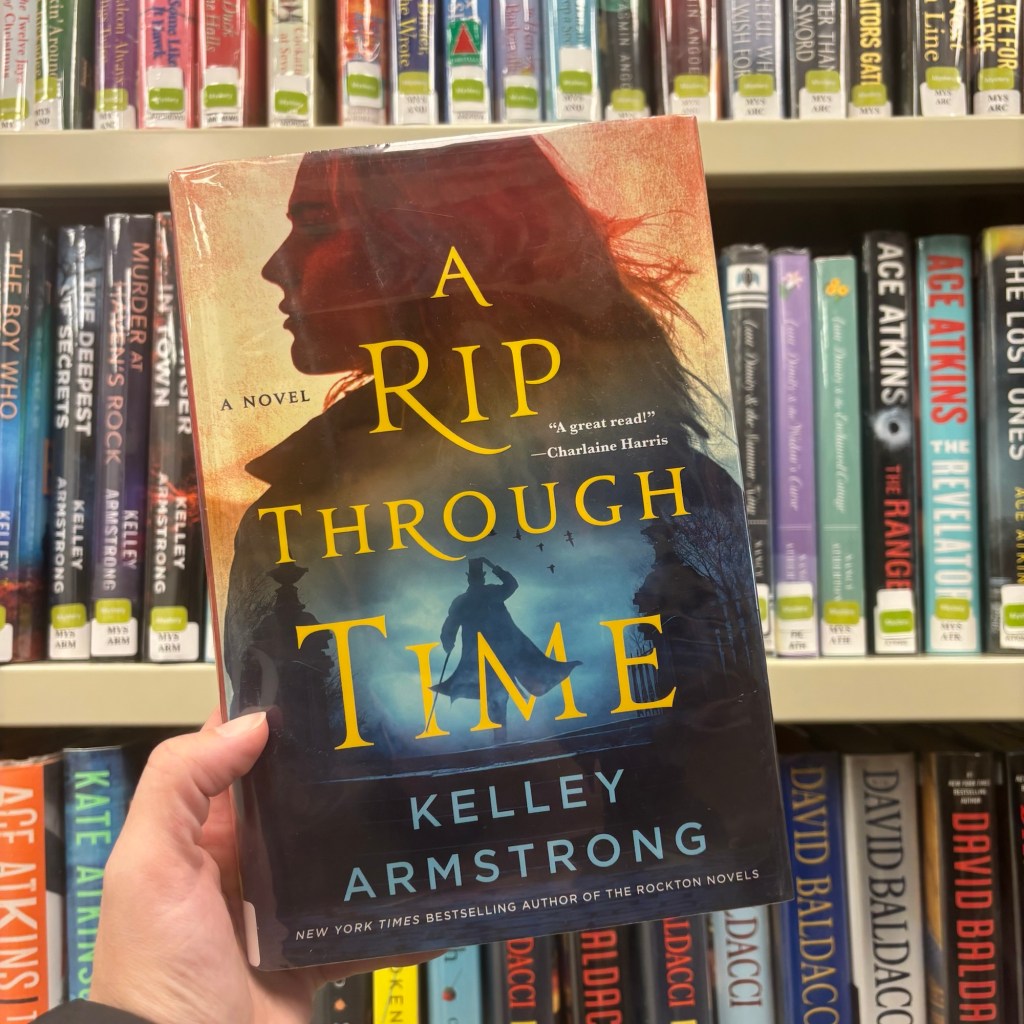
I don’t know when or why this changed, but lately I struggle to read fiction novels. These days, it takes actual effort to read beyond 50 pages of most books. By the time I do, the library book is usually overdue. I can’t tell if I’ve suddenly become bad at choosing books or if reading articles online or reading non-fiction has changed the wiring in my brain. But then, I discovered A Rip Through Time by Kelley Armstrong. It checked the boxes for beautifully illustrated setting, clever plotting, and great character chemistry, and it was the first book in years that had me turning on my book light in bed and reading until I could barely keep my eyes open.
In 280 words or less…
In this historical mystery with speculative and cozy-adjacent elements, modern-day homicide detective, Mallory Atkinson, is going for an evening jog when she hears a woman in distress. Mallory is then drawn to an alley where she is attacked and loses consciousness. When she awakens, she finds herself trapped in the body of Catriona Mitchell, a housemaid and not-so-reformed thief in 1869 Scotland. Mallory then discovers Catronia was attacked in a similar fashion that same night (some 150 years apart), which created the link needed for time travel. Mallory tries her best to assimilate into Victorian Scotland but when she learns her employer, Dr. Gray, is a medical examiner and undertaker, who works (off the record) with the local police department to solve murders in Edinburgh, she can’t resist temptation. Soon Mallory finds herself involved in solving the case of who tried to murder Catriona (as well as secretly solving the mystery of how to return to her own time period and body.)
The Review
Remember when I said lately, it requires effort from me to get passed the first 50 pages of a book? I felt that way at first about A Rip Through Time by Kelley Armstrong. It opens in a way that many cozy mystery fans would be familiar with when starting a new series: the protagonist is in the middle of a major life change and is expressing all of the strong emotions that come along with it. They may be a recent divorcee or widow, they may have just quit their humdrum job and moved to a new town for a fresh start, they may have finally retired and cashed in their life savings to start a hobby farm… In A Rip Through Time, the story opens with Mallory Atkinson, a Vancouver police detective, visiting her dying grandmother in Edinburgh, Scotland. At first, I didn’t feel anything– no grief, no connection to Mallory’s sadness. I can never tell if it’s me or if it’s the writing, but I almost returned the book to the library unfinished because of it. Once I made it to chapter five though, everything changed.
Mallory’s personality starts to take shape once she wakes up and finds herself trapped in the body of a housemaid in 1869 Scotland. She’s no longer completely preoccupied by grief now that she’s forced to navigate a culture and society that is foreign to her and is becoming acutely aware of her sudden lack of autonomy and social standing. Then, Armstrong begins to play with the “fish out of temporal water1” and “blithe spirit2” tropes, which was just fun, as modern-day Mallory stuns Dr. Gray and Detective McCreadie with her knowledge of forensics and policing. The interactions between the three are often snarky and comical. Additionally, the contrast of modern-day detective work compared to Victorian era detective work was fascinating since forensic science as a discipline was just beginning in the 1800s. The exploration of murder and forensics in this novel reminded me of a non-fiction book I read a year or two ago: The Invention of Murder: How the Victorians Revelled in Death and Detection and Created Modern Crime by Judith Flanders 3. In it, Flanders explores the relationship between murder and society in Victorian England and how, even though murder was relatively rare, it was often sensationalized which led to broadsides and theatrical performances and even laid the groundwork for detective fiction like Sherlock Holmes (and one could even say like A Rip Through Time…?)
The banter and chemistry between the characters feel all the more alive against the vividly and, at times, grimly painted backdrop of Victorian Scotland. Armstrong’s writing brought 1869 Edinburgh to life, and I found myself time traveling right alongside Mallory– to Gray’s well-kept townhouse in New Town, with penny dreadful scattered on tabletops, to the pubs and pawn shows and seedy back alleys of Grassmarket, to the muddy streets of Old Town congested with small businesses and tenements of questionable stability.
Armstrong often writes thoughtfully about the social issues of the time period too, which helped ground the story even more firmly in the past. During the story, Mallory develops a strong friendship with Isla, Dr. Gray’s sister. They become each other’s confidant– supporting each other as bold and brilliant women. Their friendship becomes a sort of subtle rebellion against the social hierarchy of the time, one that crosses economic class lines and challenges expectations based on gender. Elsewhere in the story, Armstrong explores racism and colonialism, burgeoning anti-immigrant sentiments, and the morality of scientific progress.
By the end, A Rip Through Time reminded me of the joys of escape through fiction. I had so much fun exploring a different time and a different country. As the series progresses, I’m looking forward to seeing how the relationships develop between Mallory, Gray, Isla, and McCreadie (I already have my theories!), and I’m looking forward to watching Mallory and Isla challenge gender norms in the Victorian era. About an hour after finishing the final chapter, I sneaked away from the work desk to go to the library where I checked out book two from the series, The Poisoners Ring. THAT is a testament to how much fun I had with this book. I rarely seek out the other books in a series. And if I do, it’s usually years after finishing the first book. I just really want to know what happens next!
The Teas

Your favorite Scottish Breakfast blend
Even though Dr. Gray starts his day with a cup of coffee, I’m recommending a cup of Scottish Breakfast tea instead. The tea is a blend of black teas from Assam and Ceylon, and it sometimes includes black tea from China. Of the traditional breakfast teas from the U.K., Scottish Breakfast tea tends to be the strongest, and it offers malty and oaky aromas. I love sipping this one with milk and sugar.
Victorian London Fog from Harney & Sons
I know A Rip Through Time doesn’t take place in London, but it’s does take place in the Victorian Era, which makes Victorian London Fog a lovely companion for this book. It is a blend of black tea, oolong tea, bergamot oil, lavender, and vanilla flavor. In lieu of this particular type of tea, might I recommend reaching for your favorite lavender infused Earl Grey?
Your favorite Assam
Mallory, Isla, Detective McCreadie, and Dr. Gray often meet during afternoon tea to discuss the cases, and Assam could certainly have graced the table. This malty cup of tea might give them the caffeine boost they need to keep them alert while they investigate the darkened, back alleys of Grassmarket at night.
Coffee for Mallory so she doesn’t haven’t to sip Dr. Gray’s dregs
One comfort Mallory misses from the modern day is a cup of coffee. A good cup of coffee. Mallory is desperate for the brew and the jolt of caffeine (especially since she can’t quite figure out how to wake herself up before dawn without an alarm clock), so she will sneak sips from Dr. Gray’s abandoned coffee cups.
Footnotes
- A “fish out of temporal water” trope results from characters being placed in an unfamiliar time period. ↩︎
- In the “blithe spirit” trope, “a free-spirited fish out of water goes to a straight-laced land and shakes things up” ↩︎
- The Invention of Murder: How the Victorians Revelled in Death and Detection and Created Modern Crime by Judith Flanders — it’s well-written and researched but also quite dense, so I only could recommend it to readers who have more than a passing interest in the subject matter ↩︎


